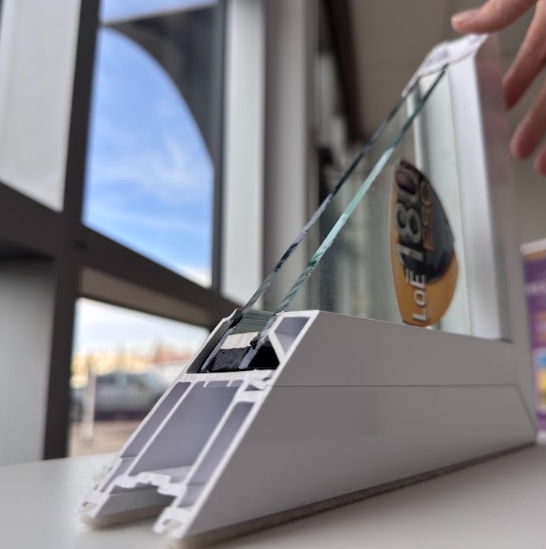

The parts of a window are the frame, the sash, and the glass, and you need to name the failed part before anyone prices a replacement. A draft at a closed sash, fog you cannot wipe off between the panes, and a sill that has gone soft are three different problems. They do not share one fix.
The frame is the box in the wall: a head across the top, a jamb on each side, and a sill at the bottom. The sash is the inner frame that holds the glass. On an operating window, it is also the part that moves. The glass in a current unit is a sealed insulating glass unit, not a single sheet. Weatherstripping, locks, cranks, and balances are what make that sash shut and stay shut. The stool, the apron, and the casing are trim.
This guide names each component, says what it does, and separates the pieces people mix up: sill and stool, mullion and muntin, spacer and glazing bead. It also matches the symptom to the part, so a replacement quote starts from the opening you already have.
Key Takeaways
- A window includes a frame, a sash, a sealed glass unit, and the seals and hardware that make the sash close.
- The frame includes the head, jambs, and sill. The stool and the apron are interior trim, not the sill.
- The sash is built from vertical stiles and horizontal rails. Where two sashes meet, that joint is the meeting rail.
- Fog between the panes means the sealed unit has lost its edge seal. A draft at clear glass is usually the weatherstripping or the lock.
- A mullion divides window units in the opening. A muntin or grille only divides the look of the glass.
- The written estimate should name the worn part and whether the existing frame stays, before it names a style.
The parts of a window
Weather Pro builds vinyl windows factory-direct in Canada for replacement on existing homes, double-glazed and triple-glazed, and installs them with its own crews. Casement, slider, hung, or fixed: changes which parts move. It does not change the names. A quote that only says “new windows” has not yet said which part of the old opening is worn out. The grid is the map. The sections after it say how each piece fails.
| Part | Where you see it | What it does |
|---|---|---|
| Frame | The box fixed in the wall | Carries the sash or the glass and ties the unit to the opening |
| Sash | Inside the frame, around the glass | Holds the glass. On an operating window, it is the part that moves |
| Insulating glass unit | The glass area | Two or more panes, sealed at the edge, with a space between them |
| Spacer | Between the panes, hidden at the edge | Keeps the panes apart and closes the cavity |
| Glazing bead | The strip tight against the glass | Holds the sealed unit in the sash or the frame |
| Weatherstripping | Where a moving sash meets the frame | Blocks air and water at that joint |
| Hardware | Lock, crank, hinge, roller, or balance | Moves the sash and pulls it onto the seal |
| Sill | Bottom of the frame, on the outside | Slopes so water leaves the wall |
The frame: head, jamb, and sill
The frame is the stationary box. On an operating window, it surrounds the sash. On a fixed window, it can hold the glass directly.
Head and jambs
Head, jambs, and sill are the three members that make that box. If one is rotten, racked, or out of square, the sash and the glass inside it can’t sit the way they were built to. The rough opening is the hole in the wall. The window frame is the manufactured box that goes into that hole. Trim hides the joint between them. A draft at that joint is an installation problem. A draft between sash and frame is a different joint.
The head is the top horizontal member. It spans the opening and, on a hung or sliding window, is part of the track the sash rides. The jambs are the two vertical sides, from the head down to the sill. Hinges on a casement, balances on a hung window, and the side track on a slider all live in or on a jamb. Name the lock jamb or the hinge jamb when you describe a rattle. A flat jamb extension only bridges a thick wall so the interior finish can meet the unit. Seal the shim space behind the casing at install. A new lock does not fill it.
The sill, and the water it has to shed
The sill is the bottom member of the frame, on the exterior. It slopes outward so rain runs off the wall. The interior ledge you set a plant on is the stool, which is trim. The water question belongs on the exterior piece.
“On a replacement, I do not start with the glass. I look at the head, the two jambs, and the sill. If that box is square and dry, we are talking about the sash and the sealed unit inside it. If the sill is soft, or the jamb is racked, a new pane will not fix the opening,” says Chris Perry, Project Manager at Weather Pro.
Two install paths follow from that look. A full-frame replacement removes the old frame and sets a new one in the rough opening. A retrofit, sometimes called an insert, leaves a sound existing frame and puts a new unit inside it. The written estimate should name the path. A soft sill, a bowed jamb, or rot behind the casing is a reason to remove the old frame. A square, dry frame can stay. The measurement decides.
The sash: stiles, rails, and the meeting rail
The sash is the frame around the glass. It can slide, swing, tilt, or stay put. When it moves, it has to land on the weatherstripping every time you close it.
Fixed glass and an operating sash
A sash that looks closed and a sash that is pulled onto the seal are different states. Knowing which you have stops a quote that prices a crank for a window that was never meant to open.
A fixed sash holds glass and does not open. It has no crank, no lock that has to pull it shut, and no weatherstripping at a moving joint. Picture windows go further: Weather Pro builds them with no operating sash and no hardware, so the glass sits in the frame and the daylight opening is as large as that opening allows. They are usually paired with an operating unit beside or below them, because the room still needs air.
An operating sash is the moving panel. Single-hung, double-hung, slider, casement, awning, and tilt-and-turn describe how that panel moves. The hardware section below matches each name to the parts that have to survive the movement.
Stiles, rails, and where two sashes meet
Stiles are the vertical sides of the sash. Rails are the horizontal members at the top and bottom. Together they are a small frame around the glass, set inside the larger frame in the wall. On a tall casement, the lock-side stile is where the hardware bites. On a wide slider, the top and bottom rails ride the track.
Where two sashes meet, those members are the meeting rails. On a double-hung window, the meeting rail is horizontal. On a slider, it is vertical. Some people call the hung version a check rail. It is the same joint, and it should close tight when the lock is engaged. A bowed meeting rail leaves a draft while the glass stays clear. The glass you see inside the stiles and rails is smaller than the frame size.
What sits inside the glass unit
Glazing is the transparent material, usually glass. In a replacement window, it is an insulating glass unit: panes sealed around the edge, with a dry space between them. The pane count, coating, gas, and spacer are all part of that one unit.
Panes, spacer, and the cavity
Canada’s March 2026 national standard covers sealed insulating glass units with two or more lites of glass used in windows, doors, and skylights. A lite is a pane. The same scope includes coated glass, bars inside the cavity, and units that contain air or argon. If that edge seal fails, the cavity is no longer sealed. Fog between the panes is the evidence, and any gas that was in the cavity is already gone.
Weather Pro manufactures double-glazed and triple-glazed vinyl windows with a SuperSpacer Premium Plus warm-edge spacer. That page describes it as a foam spacer with no metal in the edge and with desiccant, the drying agent, built in. The same product line uses a Quad Seal System. Ask on the estimate what each seal does on the unit being ordered. The public pages do not map the four locations.
Two panes and one cavity make a double-glazed unit. Three panes and two cavities make a triple-glazed unit. The spacer keeps the panes apart. You see it as the line at the edge of the glass. A warm-edge spacer conducts less heat than a plain metal bar, so that edge stays closer to room temperature. It is built into the unit. Argon, where a unit uses it, slows heat crossing the cavity compared with dry air. Coatings and pane counts are a separate choice. The short glass options note lists single, double, triple, laminated, and low-E glass. This article stops at that point.
The glazing bead is not the spacer
The glazing bead is the strip, usually vinyl, that pins the sealed unit into the sash. You see it on the interior, tight against the glass. The spacer is buried between the panes. A failed bead lets the unit rattle. A failed spacer lets moisture into the cavity. Low-E is a coating on a glass surface, usually facing the cavity, so you read it on the order rather than pointing at a separate part. Grilles inside the cavity are decorative. They are not the spacer.
Hardware that moves the sash and pulls it shut
Hardware is every piece that operates or locks the sash. Finish and metal are a separate shopping question. Here, the job is to name the mechanism that matches how the sash moves.
What each style actually uses
A worn crank should not be described as a failed frame when the glass is still clear. Fixed glass has little or no hardware. An operating window works only as long as the hardware still finishes its stroke. Match the parts below to the sash you have, or the quote will describe a window you do not own.
- Hung windows. A balance in the jamb offsets the sash weight. A lock at the meeting rail draws the two sashes together.
- Sliders. Rollers ride the sill track, and a lock at the meeting stile pulls the sashes into contact. Oil on the rollers will not correct a bowed sill.
- Casement and awning. A crank drives an arm that pushes the sash out and pulls it back. Hinges carry the sash. A lock pulls it into the gasket.
- Tilt and turn. One handle tilts the sash in from the top or swings it in from the side, and the sash locks at points around the frame.
A balance that has lost its spring lets a hung sash creep down. A crank that spins without moving the arm has stripped gears. A lock that does not draw the sash in has a keeper, the fixed half of the latch, that no longer lines up. A replacement unit comes with hardware matched to that sash. A ten-year-old crank may no longer be a stock part.
Weatherstripping, weep holes, and the screen
Weatherstripping is the resilient strip at the moving joint, where the sash meets the frame or where two sashes meet. It has to compress or brush into contact when the sash is closed, and it has to recover when you open it.
Compression, brush, and a lock that has to finish the job
A strip that has taken a set, flattened and no longer springy, leaves a gap the lock cannot close by itself. Fixed glass has no moving joint. If a picture window drafts, look at the frame-to-wall seal and the glass unit.
Casement, awning, and tilt-and-turn sashes typically seal by compression. The crank or the handle pulls the sash in, and the gasket squashes around the perimeter. A slider or a hung window seals by contact along the track and at the meeting rail. Brush or pile in the track blocks air only if the sash sits on it. Dirt, a dropped roller, or a lock that does not meet holds the sash off the seal.
A tired strip is cracked, flattened, or pulled out of its slot. With the sash latched you feel a cold line at the meeting rail while the panes stay clear. Caulking that joint shut can trap water that should drain.
Where water is supposed to leave
Sliders and hung windows can let a little wind-driven rain past the first contact line. Water is meant to drop into the sill and leave through small exterior openings, often called weep holes. Those slots are easy to paint shut. Sealed weeps leave the water in the frame. If you see them on the outside of the sill, leave them open. Match the slots on the unit in front of you. A published diagram of Weather Pro’s weep layout is not in the client materials.
The screen is mesh on its own small frame. A torn screen is a screen job. It does not show that the glass unit has failed.
“Fog you cannot wipe off, sitting between the panes, is a failed seal in the glass unit. A draft at clear glass is a different part: the weatherstripping, or the lock that is supposed to pull the sash into it. I want those named on the estimate before we talk about a style,” says Chris Perry, Project Manager at Weather Pro.
Stool, mullion, and grille
Inside the room, you mostly see trim and the glass. Outside you see the sill, the exterior casing, and the cover over the joint between frame and cladding. Between two windows, the bar is either structure or a pattern on the glass.
What you see from the room, and from the yard
Trim does not hold the glass. A new coat of casing hides the drywall gap. It leaves fog in the cavity untouched.
From inside, the stool is the flat ledge. The apron is the horizontal trim under the stool. Casing is the moulding around the frame that covers the gap to the finished wall. On a full-frame replacement, those pieces often come off. On a retrofit, they can stay if they are sound and the new unit fits the old frame.
From outside, brickmould or exterior casing covers the joint between the frame and the cladding. A drip cap, or head flashing, sits above the head and kicks water out over that casing. Natural Resources Canada’s diagram of a double-hung unit in a wall includes the drip cap or flash, the exterior casing, the frame, and the sashes, and it marks air paths at the rough opening and at the sashes. Water at the head flashing is a wall detail. Air at the meeting rail is a sash detail.
A mullion divides units. A muntin divides the look
A mullion is the structural member that joins window units in one opening, such as a picture unit with a casement on each side. It carries load and keeps that joint weathertight. You cannot lift it off to wash the glass.
A muntin is a bar that divides the glass into smaller lights. Most replacement glass is one sealed unit, so the divided look is added in one of three ways.
- Grilles between the glass. Bars sit inside the cavity. You wipe a smooth pane. You cannot change the pattern later.
- Simulated divided lite. Bars are applied on the indoor face, the outdoor face, or both, over a single unit. They mimic a true divided light, and they do collect dust.
- True divided lite. Separate panes, with muntins between them. Rare on a modern sealed unit, and a different glass order from a grille kit.
If a quote says “colonial bars” or “grids,” ask whether they are inside the glass or on the face. The curb view can match. Cleaning does not.
Which failed part the quote should name
Fog, a cold draft, a sash that will not stay up, and water on the stool each point at a different component. Replacing the whole opening can still be the right job. The first line of the quote should still name the part that failed.
Read the symptom before you name the style
Natural Resources Canada states that when condensation sits inside a sealed double-glazed unit because the seal is broken, the fix is to replace the glazing unit. The same page calls refurbishing that failed unit a temporary fix. Check the warranty before anyone drills the edge. A clear pane with a draft is a weatherstripping or hardware question. Weather Pro replaces windows in existing homes, built to the measured opening, and the symptom still decides whether the old frame can stay.
Walk the opening once, from the room and from outside, and write down what you actually see.
- Fog or mineral stains between the panes. The edge seal of the insulating glass unit has failed. Wiping the room-side face will not clear it.
- Clear glass, cold at the meeting rail. The sash isn’t landing on the weatherstripping, or the lock isn’t pulling it in.
- A sash that slides down or a crank that spins free. The balance or the operator has failed. Look at the jamb hardware before you blame the frame.
- Water on the stool after rain, with dry glass. Suspect the frame-to-wall joint, the drip cap, or weeps that have been plugged, not the coating on the glass.
- A soft, dark, or crumbling sill. The frame is done. A new sash in that box will not stay square.
- A torn screen or a stiff crank, and no draft when latched. Those parts can be serviced or replaced with the unit. They are not, by themselves, a failed sealed unit.
What the estimate should write down
Ask for these lines in plain language. A style name without them is a catalogue page, not a scope.
- Which part failed: glass unit, weatherstripping, hardware, frame, or the joint to the wall.
- Frame path. Full-frame (with the old box removed) or retrofit into a frame that was checked and is still sound.
- Sash and hardware. Operating or fixed; the operator that matches it, and which side a casement hinges on.
- Glass unit. Double or triple, grille inside the cavity or on the face, and the spacer, kept separate from the glazing bead.
- Trim and drainage. Whether stool and casing stay, whether a drip cap is in the job, and that weep holes stay open.
Name the worn part before you replace the window
A window is a frame in the rough opening, a sash that lands on a gasket or pile strip, and a sealed glass unit that fails by fogging between the panes. Hardware and weatherstripping make the close real. Trim, mullions, and grilles sit around that core.
Name the symptom in those words. Fog is the glass unit. A whistle at clear glass is the seal or the lock. A soft sill is the frame. A crank that spins is the operator. Water on the stool is the joint to the wall or a weep that cannot drain. Style comes after that, because a casement and a slider put those same parts in different places.
Weather Pro builds the vinyl frame, the sash, and the glass as one factory unit and installs it with its own crews. The part names still belong on the estimate, including whether the existing frame stays. Bring the list from the walk-through. Get a free in-home estimate and point to the head, the jamb, the sill, and the glass, not just the room.
Frequently Asked Questions
What are the parts to a window called?
The main names are the frame, the sash, and the glazing. The frame includes the head, jambs, and sill. The sash splits into stiles and rails. In a modern unit, the glass is an insulating glass unit held in by a glazing bead, with a spacer between the panes. Locks, cranks, balances, and weatherstripping are the operating parts. Stool, apron, and casing are trim around the frame, not the window itself.
What are the sections of a window?
Think in three bands. The outer section is the frame in the wall, including the sill that sheds water. The middle section is the sash, or the glass set directly in the frame on a fixed picture unit. The inner section, from the room, is the glazing bead, the lock or crank, and the interior trim. If two windows share one opening, the bar between them is a mullion, which is frame, not trim.
What are the components of a home window?
A home window needs a frame, a way to hold the glass, the glass unit itself, a seal at every joint meant to stop air and water, and hardware if the sash moves. Screens, grilles, and interior casing are common, and they do side jobs: keeping out insects, adding a divided-light look, and finishing the wall. None of those three holds the sash square or keeps the cavity between the panes dry.
What are the main components of windows?
Frame, sash, and insulating glass unit are the three that define the product. Weatherstripping and hardware are the next tier, because they decide whether an operating sash actually closes. Spacer and glazing bead are smaller, and people often swap them by mistake. If you remember only five words for a site visit, use frame, sash, glass, seal, and lock.
What are the 5 parts of a window?
There is no official set of five, but a practical five is the frame, sash, glass unit, weatherstripping, and hardware. That set covers structure, the moving panel, the sealed pane, the air-and-water joint, and the piece that pulls the sash shut. Sill, stool, mullion, and grille sit under those headings. If someone offers a different five, ask which job each name does. A list that skips the sill will miss the usual draft.
What are the parts of a window frame?
The frame is the head, the two jambs, and the sill. Mullions are frame members too, when one opening holds more than one unit. Jamb extensions and brickmould sit at the frame, alongside the head and the sill. The stool is not part of the frame. It is the interior ledge. On a replacement, confirm whether the word frame in the quote means this manufactured box or the rough opening in the wall.
What are the parts of a window sash?
Stiles on the sides, rails on the top and bottom, and the glass unit they surround. Where two sashes meet, those members are meeting rails. The glazing bead that pins the glass in is part of the visible sash assembly. Depending on the style, balances, rollers, and locks may be mounted on the sash or the frame. A fixed picture unit from Weather Pro may have no operating sash at all, which is why it has no crank and no meeting rail.
What are the exterior parts of a window?
From the yard, you should be able to pick out the sill, the exterior casing or brickmould, and often a drip cap above the head. Weep openings, when that style has them, are small slots on the outside of the sill track. The outdoor face of the glass is part of the insulating glass unit, not a separate storm pane, unless an old storm window is still mounted over the unit. Exterior parts shed water. If they are buried in caulk or paint, water stays in the frame.
What are the parts of a window sill?
The sill proper is the exterior bottom member of the frame, sloped to drain. Under it, on some installs, a sill pan or flashing catches water that gets past the frame. The interior stool is the flat shelf, and the apron is the trim under that shelf. People call all three “the sill.” Only the exterior piece sheds water. If that piece is soft, the conversation is about the frame, not about a new plant ledge.