
Window glass options come in four choices: pane count, low-E coatings, the gas filling the gap, and whether any lite is tempered or laminated. The opening decides the mix. Direction, the chance that someone hits the glass, and the condition of the frame matter more than a single upgrade label on a brochure.
Weather Pro builds vinyl replacement windows in Canada. The published glass package is double pane with a low-E coating and argon, or triple pane with a third pane and a second sealed cavity. Safety glass sits beside that energy package. Specify it when the location needs it. The spacer at the edge of the unit is part of the same assembly, and you can’t judge the tint from the sidewalk.
This guide follows the order in which a measurement usually raises those choices. It explains what each one changes, what a quote should name, and when a new piece of glass leaves the real problem in the wall. A separate guide covers when double-pane or triple-pane is the better fit for a given elevation. This page focuses on how to tell the glass itself apart.
Key Takeaways
- Pane count, a low-E coating, the gas in the gap, and tempered or laminated glass are four different lines on a quote.
- Double pane with low-E and argon is the standard Weather Pro package. Triple pane adds a second sealed cavity.
- A low-E coating manages heat. Fully tempered glass and laminated glass are safety products, and they break differently.
- Canada’s 2026 safety-glazing standard defines those two break patterns and lists doors, panels beside doors, guards, patio doors, and tub or shower enclosures as areas of human impact.
- Fog between panes means the seal has failed. A soft or out-of-square frame is a different repair from a new sealed unit.
- The estimate should name the package, the spacer, which lites are safety glass, and whether the existing frame stays.
What glass options for windows should the quote name
A vinyl window from Weather Pro is a frame, a sash, hardware, and a sealed glass unit. The glass unit is what people mean by the glass package. Ordinary annealed glass is the clear sheet the industry starts from. A single-glazed product has one pane. A double-glazed product has two. A triple-glazed product has three. Those counts come from Natural Resources Canada’s chapter on upgrading windows, and they are definitions, not a ranking.
The published Weather Pro package starts at double pane. Two panes, a low-E coating, and argon in the gap are the standard. Triple pane adds the third pane and a second sealed cavity. The pricing page describes that step as lower heat loss and less outside noise, and it says many homeowners put triple pane on north- and west-facing elevations and keep double pane elsewhere. That split is a layout choice. It is not a rule that every opening in the house must match.
Safety glass does not replace that choice. Fully tempered glass and laminated glass change how the lite behaves when it breaks. They can be built into a double-pane or a triple-pane unit. A quote that says only “energy glass” or “upgrade glass” has skipped the lines that change the price and the code question. Ask for the four lines in writing before you compare two estimates.
| Choice | What is in the unit | What to confirm |
|---|---|---|
| Single lite | One sheet of glass and no sealed gap | This is the old glass you are leaving behind |
| Double pane | Two panes, a low-E coating, argon in one gap | Standard package for that style and size |
| Triple pane | Three panes and a second sealed cavity | Which elevations get it |
| Tempered | Heat-treated glass that breaks into granular pieces | Which lites, and that a permanent mark is on the glass |
| Laminated | Glass bonded to an interlayer that holds fragments | Which lites, and that the mark is not tempered-only |
The guide covers which elevations require a third pane, versus a double-pane window. If two quotes disagree, match the glass lines before you compare labour. A fourth pane, sometimes called quad glazing, appears in the same federal chapter. It is not part of the published Weather Pro package. A suspended polyester film used as one layer inside a triple unit is also a different product from a sheet stuck on the room side of old glass. If a quote mentions film, ask which of those two it means.
Low-E windows and argon-filled windows
Low-E is a coating and argon is a gas, and a quote can include one without the other. On a Weather Pro window, the published standard includes both, in a double-pane unit, with triple pane as the step up. Read both on the estimate, then check the label that ships with the window.
How a low-E coating manages heat
Natural Resources Canada describes a low-E coating as a fine, factory-installed transparent metal coating on one or more glass surfaces. The same chapter says these coatings can reduce heat loss in the winter and heat gain in the summer by up to 50%. That figure is about the coating’s effect on heat transfer through the glass. It is not a promise about your gas bill, and it is not a Weather Pro energy rating.
The chapter splits coatings into two behaviours. A passive low-E coating has a high solar heat gain coefficient, so more of the sun’s heat comes indoors during the heating season. A solar-control low-E coating has a lower solar heat gain coefficient, so less of that heat comes in when a room overheats. Weather Pro’s public pages name low-E as part of the standard package and do not publish a solar-heat-gain number for each elevation. If one room overheats or one wall stays cold, ask which behaviour the coating in the quote actually has.
The same chapter gives 12 to 16 mm (1/2 to 5/8 in.) as the gap width that limits convection inside the unit. A gap that is too narrow conducts heat across the space. A gap that is too wide lets the fill circulate. The quote should describe a sealed unit, not a single lite with a storm panel added later.
Low-E is not safety glass. A coating doesn’t change how the sheet breaks. If the opening is a door, a panel beside a door, or a tub enclosure, the safety question remains open after you choose the coating. Tinted glass is a different product again. A tint absorbs light and heat. It does not do the job of a low-E coating, and a solar-control film applied afterward is not the factory coating. The federal chapter notes that solar-control films add little insulation, cut winter solar gain, can stress the glass, and may void the warranty issued by the original window manufacturer.
“People hear low-E and picture a dark tint. On the houses I measure, the coating manages heat, and the glass still looks clear from the sidewalk. I want the quote to say double pane or triple pane, with low-E and argon written out, rather than a line that only says energy glass.” – Chris Perry, Project Manager, Weather Pro Windows and Doors
Argon in the gap, and the spacer at the edge
The federal chapter says the space between the panes is filled with an odourless, colourless inert gas such as argon or krypton, which reduces heat transfer through the glass. Weather Pro’s published standard fill is argon. If a quote says “gas filled” and does not name the gas, ask for argon or for the gas that will actually go in the unit. Krypton is not named as a Weather Pro option on the pricing page or the resources page.
The spacer is the bar or foam that holds the panes apart and seals the edge. A metal box spacer moves heat to the glass edge, where condensation often shows first. A warm-edge spacer uses a less conductive material so the edge stays warmer. Weather Pro uses SuperSpacer Premium Plus on the windows it manufactures. The resources page describes it as a foam warm-edge spacer and credits it with argon gas retention and a durable edge seal. Those are product facts from that page. They aren’t a whole-window energy rating, and they don’t replace the pane-count choice.
More glazing layers reduce outdoor noise. The federal chapter states that it doesn’t include a decibel figure. If traffic noise is why you called, say so at the measurement, and keep a laminate as its own line rather than folding it into pane count.
Tempered glass and laminated glass
Fully tempered glass and laminated glass are different safety products, and a low-E coating on either one does not satisfy a safety note on a door. CAN/CGSB-12.1-2026, published in March 2026, defines those words and the permanent mark. Provincial codes decide when a replacement must use a product that meets the standard.
Where human impact changes the glass
The standard covers glazing tested to reduce cutting and piercing injuries. It does not set strength, fire rating, appearance, or installation method. Its informative annex lists areas of human impact: doors, glazed panels adjacent to doors, passageway doors, storm doors, guards, patio doors, and shower and bathtub doors and their enclosures. The list is not exhaustive. A bedroom window high in the wall is a different conversation from a patio door or a pane beside a tub. Ask the estimator to mark every lite in one of those spots, including a sidelite next to an entry door and the glass in a patio door.
Monolithic annealed glass is ordinary glass, and the standard says it is not safety glazing. Monolithic heat-strengthened glass is also not safety glazing under this standard. Heat-strengthened and fully tempered are different treatments. A quote that says “heat treated” is incomplete until it specifies fully tempered or laminated and references the standard.
Conforming products are permanently marked with the supplier’s name or designation, the standard designation CAN/CGSB-12.1, a test-size class, and a drop-height class. After the unit is in, you should be able to find that mark. If the quote promised safety glass and the mark is missing, raise it before the job is closed.
How the two kinds of safety glass break
Fully tempered glass, also called toughened glass, is heated and then cooled quickly so the surfaces lock into compression. When it breaks, the whole lite cracks at once into very small, granular pieces. Those pieces are the point of the product. The sheet does not stay in the opening as a single cracked pane.
Laminated glass is one or more sheets bonded with an organic interlayer. When it breaks, many cracks can appear, and the fragments tend to adhere to the interlayer, so the opening can stay covered. Tempered glass falls away as granules. Homeowners also ask about laminates for forced entry or for sound. The 2026 standard answers the injury question. Ask for security or noise as their own lines.
A sealed unit can combine them. One lite in a double-pane unit might be tempered, or the room-side lite might be laminated, with low-E and argon still included. Weather Pro’s public pages do not publish a price for tempered or laminated lites. The estimator writes that configuration down. The standard energy package doesn’t include it.
“If the glass is in a door, beside a door, or down at the floor in a patio unit, I write the safety line on the quote before we talk about colour or grilles. Fully tempered and laminated do not break the same way, and the homeowner should see which word we used. A coating does not cover that line.” – Chris Perry, Project Manager, Weather Pro Windows and Doors
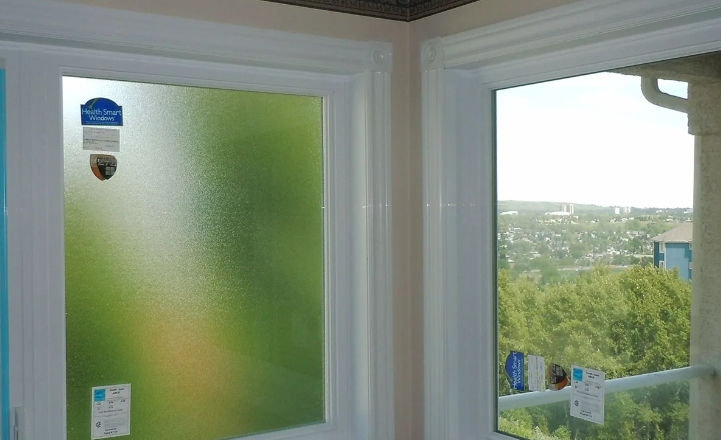
A patterned or frosted lite is a privacy request. It is not low-E, and it is not automatically safety glass. A tub or shower enclosure may need both. Put both words on the quote.
Window glass replacement and a frame that is still sound
Window glass replacement, as homeowners say it, usually means the sealed unit has failed and they hope the frame can stay. Fog or droplets between the panes that you cannot wipe off are the usual sign. Natural Resources Canada treats condensation inside a sealed unit as a broken seal, and it treats a refurbished sealed unit as a temporary fix that will not offer the same original energy efficiency. The chapter points to replacing the glazing unit as the correction, and it tells you to check whether the window is still under warranty.
That job stays small only if the frame, sash, and opening are still sound. Weather Pro’s pricing page describes a retrofit as keeping a sound frame: the old sashes and glass come out, the new unit goes into that frame, and the interior trim can stay. A full-frame replacement is the path when the frame is rotten, racked, or no longer square. Measurements determine which path you are on.
Ask these questions before you accept a glass-only price from anyone.
- Is the moisture between the panes, or is it on the room side where a cloth can remove it? Room-side fog is often humidity. If it’s between the panes, the seal has failed.
- Is the frame dry, square, and solid when you press the sill and the jambs? Soft wood or a bowed vinyl frame changes the job.
- Does any sash still operate, lock, and meet the weatherstripping? A failed seal plus a sash that does not close is two problems.
- Is the quote for a new sealed unit in the existing sash, a retrofit window, or a full-frame window? Those are different products.
- If the old unit is under a warranty, who is honouring it, and does the remedy match the failure?
Weather Pro’s published work is replacement windows and doors on existing homes, manufactured and installed by its own crews, with a transferable lifetime warranty on that work. If you want that window, the quote should be for the window, installed. If you want only a sealed unit because the frame is proven sound, say so at the visit so the estimate does not assume a full opening.
A calendar date is a weak clue. Fog between the panes with a square, dry frame is a glass problem. A dry seal with a rotten sill is a frame problem. If the failed unit has grilles between the panes, the replacement line should say whether the grilles return. Grilles do not change the energy package.
What the glass line on the estimate should list
Two estimates can differ because one of them left out a pane, a safety lite, or disposal of the old window. The pricing page is a budgeting list for installed vinyl windows. It is not a contract. The exact figure follows a free in-home measurement. Bay, bow, and specialty shapes are quoted from the configuration.
On that page, triple pane adds about 20 percent to the same window on most of the range, from 9 percent to 50 percent depending on style and size. The largest sliders sit at the high end of that spread. A medium casement is listed at $650 to $960 for double pane and $780 to $1,150 for triple pane. Those ranges are installed prices for budgeting: the window, labour, sealing, and finishing. They are not supply-only glass prices, and they do not include a tempered or laminated upcharge. White is the standard finish. A colour or laminate on the frame is a separate upcharge with no published dollar amount on the page.
Read every glass line against this list before you sign.
- Pane count is written as double pane or triple pane, and the elevations that get triple pane are named.
- Low-E is written as a coating, and argon is named if that is the fill. “Energy package” alone does not pass.
- Identify any tempered or laminated lite by room and by which sheet in the unit it is.
- The spacer is named if you were shown SuperSpacer Premium Plus as part of the manufactured window.
- The price is installed, and it says whether the existing frame stays.
- Removal and disposal of the old unit are included or priced separately, so you can see them.
- The label that ships with the unit is the one to keep. A centre-of-glass talking point leaves out the frame.
List prices on the site are described as the same across provinces, and double-pane or triple-pane is what usually moves the number. ENERGY STAR on Weather Pro product pages means certification for the Canadian climate zones in which the windows are sold. That sentence is not a U-factor and not a model number. Ask for the rating digits on the quote for the unit being built. A lower total that dropped the third pane, or that left safety glass off a patio door, is a different job.
Where a glass upgrade will not fix the opening
New glass makes the transparent part of the window perform as specified. It does not rebuild the wall, the flashing, or a sash that no longer meets the frame. Homeowners run into the same issues after the unit is in, and most of them were visible on the day of the measurement.
- Room-side condensation comes back because the new unit is tighter, and indoor humidity had a leak to escape through before. The federal chapter notes that old leaky windows can hide that humidity, and that triple glazing helps edge fog in harsher climates. Ventilation belongs in the same conversation as the glass.
- The edge still runs wet because the spacer and the install gap were never discussed. A warm-edge spacer is part of the unit. Foam in the gap between the frame and the rough opening is part of the install. Ask which foam goes in that gap.
- A solar-control film goes on the new glass in the first summer, cuts the winter heat you wanted from the sun, and may void the window warranty. Decide on the coating with the estimator instead of layering a film later.
- A patio door or a tub enclosure is ordered as standard annealed glass inside a double-pane unit. The energy package is real. The safety mark is missing. Send that back before the trim is finished.
- The frame was soft, the retrofit went ahead, and the sash binds on the first cold week. Glass choice did not cause that. The frame path did.
- Two rooms on the same wall were quoted as different packages with no note on why. North and west can justify triple pane. A random mix, with no elevation written down, is how the wrong unit arrives.
Say the goal in one sentence at the start of the visit: a clearer view through a fogged unit, a warmer north wall, or a door and a low pane someone can fall against. The first is a seal-and-frame question. The second is pane count and coating, and the double-pane versus triple-pane guide carries that comparison. The third starts with the safety standard.
A glass package is four lines, then a measurement
Glass options come down to pane count, a low-E coating, the gas in the gap, and whether any lite is tempered or laminated. Double pane with low-E and argon is the standard Weather Pro package. Triple pane adds a pane and a second cavity, with a published price step that depends on style and size. Safety glass follows the opening: doors, panels beside doors, guards, patio doors, and tub or shower enclosures are the human-impact spots named in the 2026 standard.
The coating can cut heat loss and heat gain. Argon is the published fill, and the spacer helps keep it in the unit. Fog between the panes means the seal has failed. A rotten or racked frame means you need a new window. Write the frame path beside the glass lines so the price you accept matches the job you’ll build.
Bring the opening list to a free in-home estimate. Ask for double pane or triple pane, low-E, argon, any safety lite, and whether the frame stays. That is the glass package, in the words a second quote can match.
Frequently Asked Questions
What are low-E windows?
Low-E windows use a transparent low-emissivity coating that helps reduce heat loss in winter and heat gain in summer. Weather Pro includes low-E with argon in its standard double- and triple-pane packages. The coating is not safety glass.
What are argon-filled windows?
Argon-filled windows have inert gas between the panes instead of ordinary air alone. Weather Pro uses argon with low-E glass. You cannot see or smell the gas, and fog between panes indicates a failed seal.
What is window glass replacement?
Window glass replacement usually means installing a new sealed unit when the glass has fogged between the panes. It works when the frame and sash are still solid. Use a full-frame replacement when the frame is rotten or racked.
Is laminated glass the same as tempered glass?
No. Tempered glass breaks into small granular pieces, while laminated glass cracks but usually stays attached to its interlayer. Both can qualify as safety glazing under CAN/CGSB-12.1-2026 when they meet the standard.
Does every window need triple pane glass?
Not every window needs triple pane glass. Weather Pro says many homeowners use triple pane on north- and west-facing elevations and double pane elsewhere. The right choice depends on the home’s needs and the window specification.
Can a tint or a film replace a low-E coating?
No. An after-market tint or film does not replace a factory low-E coating inside a sealed unit. Solar-control films can affect solar gain, glass stress, and the manufacturer’s warranty. If privacy is the goal, ask about patterned glass.
What should the glass line on a quote include?
The glass line should specify double- or triple-pane, low-E, argon, tempered or laminated glass, and the spacer, if applicable. It should also state whether the existing frame stays and whether removal is included.
How can I tell that safety glass was actually installed?
Look for a permanent mark on the glass. CAN/CGSB-12.1-2026 requires conforming safety glazing to carry specific markings, including the supplier designation, standard designation, and test classifications. If you cannot find the mark, raise it before signing off.