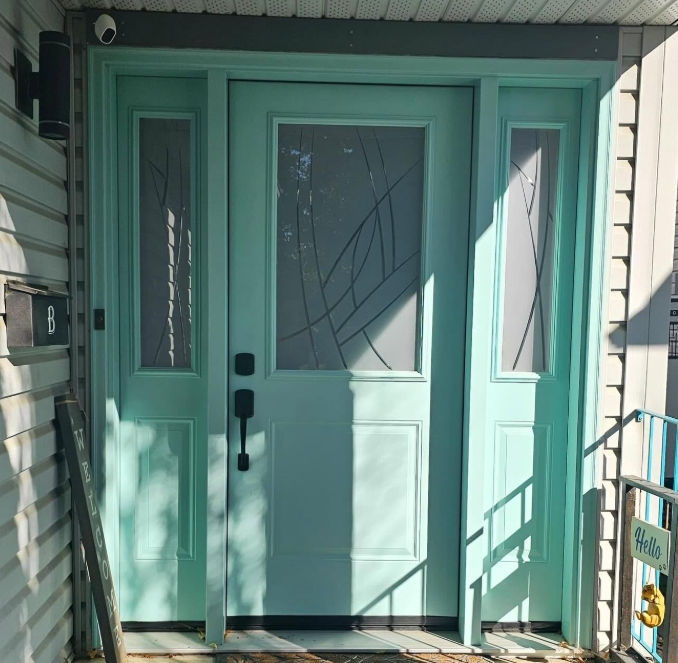

An entry door that will not latch or close properly almost always has a latch that no longer meets the strike plate. The slab has dropped on tired hinges, the frame has moved with the house, weatherstripping is holding the door off the jamb, or the hardware was never reset after seasonal movement. A new handle rarely fixes that geometry.
Those causes show up as different symptoms. You lift the knob to catch the latch. You slam the door and still hear it rattle. The latch hits metal instead of dropping into the hole. The deadbolt turns only if you lean on the slab. The door binds on the threshold in January and swings free in July. Each pattern points to a different part of the opening, not to a single “bad lock.”
This article covers how a latch is supposed to meet a strike, how to read gaps and rub marks, what Canadian freeze-thaw and indoor humidity do to wood and metal, which homeowner checks are safe, and when another hardware tweak is wasting a winter that a full entry unit would actually close.
Key Takeaways
- The latch and the strike have to occupy the same millimetres. If they don’t, the door isn’t secure, no matter how new the lock looks.
- Tightening hinge screws is the first honest test. A dropped slab masquerades as a failed latch.
- Rub marks on the strike plate tell you high, low, or short. Guessing with a bigger hole only hides settlement.
- Canadian winters move wood frames and change indoor humidity. A door that latches in July and misses in January is showing climate, not a mystery.
- Weatherstripping that is too fat, too hard, or stacked with a storm door can hold the latch off the pocket.
- A slab dropped into an old jamb does not keep an ENERGY STAR rating. Alignment and the frame travel together.
- Soft wood around the strike, a racked opening, or a warped slab is past a file-and-hope repair.
Why an entry door will not latch or close properly
A residential swinging door is a leaf in a frame. The latch is a spring-loaded bolt in the edge of the leaf. The strike plate is the metal opening on the jamb that this bolt is supposed to enter. Close the door slowly, and the latch should hit the curved lip, compress, then spring into the pocket. If it hits steel, rides over the plate, or never reaches the hole, the door is not latched. It may look closed. It is not locked against a shoulder.
That miss is usually millimetres. Houses settle. Hinge screws back out. Wood jambs shrink in dry heat and swell when the air is wet. Steel and fibreglass slabs move less than wood, but they still hang on hinges screwed into a wood or composite jamb that does move. The hardware did not “go bad” on its own. The rectangle around it changed.
Read the opening before you buy parts. Check the reveal: the gap between the slab and jamb on the hinge side, the latch side, the head, and the sill. Even gaps mean the leaf is still square in the frame. A fat gap at the top latch corner and a tight gap at the bottom latch corner usually means the door has sagged. A tight head on one side and a tight sill on the other usually means the frame has racked. Those two pictures need different work.
Natural Resources Canada treats the door as part of the same envelope as the windows. Windows, doors, and skylights can account for up to 25 percent of a home’s energy loss, and ENERGY STAR certified doors are about 15 percent more efficient than average. A latch that never seats also means the weatherstrip never compresses evenly. You feel that as a draft at the lock side long before you see it on a utility bill.
Strike plates that no longer meet the latch
The strike is the easiest part to blame and the last part you should move. If you relocate the plate while the door is still dropping, you will chase the miss every season. Confirm where the latch actually lands, then decide whether the plate, the hinges, or the frame is the true offset.
A simple mark test is enough. Colour the latch face with chalk, a grease pencil, or lipstick. Close the door gently onto the strike without forcing it. Open it and look at the smear. A mark above the hole means the latch is high. A mark below means it is low. A mark on the outer lip with no colour in the pocket means the latch is not reaching far enough. Paint on both the lip and the far edge of the hole means the pocket is too shallow or the plate is proud of the jamb.
Typical strike problems look like this:
- Screws backed out. The plate has walked a millimetre or two. Tightening often restores the original position.
- Bent lip. Years of slamming fold the lead edge. The latch rides up instead of in.
- Shallow pocket. The latch enters the plate but bottoms on wood chips, old filler, or a strike that is too thin for a longer bolt.
- Deadbolt and latch on different stories. You can throw the deadbolt only by lifting the door. The latch strike and the deadbolt strike no longer share a centreline.
- Soft jamb. The screws spin. The wood around the mortise is crushed from a past kick or from water at the lock side.
If the miss is a hair, a slightly larger opening in the plate can be enough. If the miss is obvious, moving the plate without fixing sag only records the sag in metal. Fill old screw holes so the next fasteners actually bite. Treat the latch and the deadbolt as two alignments. They use separate pockets.
Hinges that let the slab drop
Gravity wins on every hinged leaf. The top hinge carries most of the weight. When those screws loosen, the latch side of the door drops and the latch aims below the strike. Homeowners often describe this as “I have to lift the door to lock it.” That sentence is a hinge diagnosis wearing lock language.
Stand outside with the door open a few centimetres and look down the latch edge. If the top of the door has drifted toward the strike jamb, the hinges have given up a little height. Wiggle the slab toward the latch side. Play at the hinge knuckles means the screws are no longer clamping the hinge leaf to solid wood, or the hinge itself is worn.
Work the hinge side in this order:
- Close the door and confirm all hinge screws on both the slab and the jamb are snug. Do not strip the heads.
- Replace a spinning screw with a longer fastener that can reach framing behind the jamb, especially on the top hinge.
- If the hinge mortise is crushed or the knuckle is oval, the hinge is spent. A new hinge on chewed wood still sags.
- Shimming behind a hinge leaf can tilt a slightly twisted slab back toward square. That is a small correction, not a repair for a racked opening.
“Most latch misses I see are millimetres, not a failed lock. The door dropped on the hinges, or the strike never moved when the house did. Tighten the top hinge and look at the gaps before you buy another deadbolt,” says Chris Perry, Project Manager at Weather Pro Windows and Doors.
A steel or fibreglass entry door is heavier than an interior hollow slab, and glass inserts add weight at the lock stile. That is normal. What is not normal is hinges that never reached framing, or a new leaf hung on a split jamb. If every screw is tight and the door still hangs low, the jamb, header, or sill has moved. Filing the strike then is cosmetics on a wall.
Canadian freeze-thaw, humidity, and a door that changes with the season
Canadian entries live through dry indoor heat, wet shoulder seasons, and outdoor swings that wood does not ignore. A door that latches all summer and misses after the first cold snap is a common service story, not a unique defect. The reverse is also true: a door that binds in a humid July and frees up in January is swelling, not “warped forever” until you prove the slab will not recover.
Weather Pro’s help notes on a door stuck in winter point to expansion in the cold, moisture in wood, and indoor humidity that also shows up as condensation. That page is written for products already in the house. The same physics apply to any wood jamb and any wood-edged slab, whether the unit is ten years old or forty.
Freeze-thaw isn’t just ice on the step. The rough opening sits on a foundation that moves a little as the ground freezes and thaws. Over years, that movement is enough to throw a strike off by the width of the latch bolt. You will see it as a wider gap at the head on one side, a threshold that is no longer level, or weatherstripping that is crushed at one corner and loose at the other.
Wood slabs versus steel and fibreglass
Wood absorbs and releases moisture. It is the material most likely to swell at the latch edge after a wet week and shrink after a long stretch of furnace air. Planing a wood door because it stuck in August can leave a winter gap you then try to hide with thicker weatherstripping. That thicker strip then holds the latch off the strike.
Steel and fibreglass skins move far less across the slab face. They still depend on a jamb, a threshold, and hinge screws. A steel door that suddenly will not latch is rarely “the steel warped.” Look at the frame, the sill, and the hinges first. Fibreglass handles Canadian moisture and temperature swings well on the slab itself. It will not square a racked opening.
Calgary Chinooks add a same-day temperature swing on top of ordinary freeze-thaw. The slab and the jamb don’t change size at the same rate, so the latch can miss for a few hours and then catch. If that pattern repeats all winter, the opening was already close to the edge of alignment.
Indoor air that dries the jamb
Heating season dries interior wood. A jamb that was snug in October can shrink by February so the latch no longer reaches, or the slab hangs slightly differently and hits high. Showers, cooking, and indoor drying load the air the other way. Wood at the lock stile picks that up. If you see heavy condensation on glass inserts, the air is too wet for the surface temperature. Exhaust fans that duct outdoors do more for a sticky wood edge than lubricant.
Lubricant still has a place. A dirty latch that will not spring out will miss a perfectly aligned strike. Clean grit from the bolt and use a product meant for locks, not a heavy grease that packs with dust. Sluggish in open air is the lockset. Lively in open air and dead against the plate is alignment.
Frames, thresholds, and weatherstripping that hold the door off the strike
Sometimes the latch and the plate would meet if the slab could finish its swing. Thick-pile weatherstripping, a storm door that does not close in sequence, a raised threshold, or a closer that dumps the door into the strike too hard can all stop the latch short.
Walk the perimeter with the door closed as far as it will go without a hip check:
- Daylight at a corner means the leaf is not in plane with the frame. The latch may be the least of the leak.
- A threshold that scrapes the bottom of the slab will stall the door before the latch arrives.
- Weatherstripping that is flattened on the latch side and untouched on the hinge side is being asked to close a twisted gap.
- A storm or screen door that hits the entry slab can bounce the latch out of the pocket the instant it tries to catch.
- Ice at the sill in winter is a drainage and sealing problem. Forcing the door over ice chews the bottom weatherseal and lifts the latch off line.
Replacement weatherstripping is a reasonable first pass when the frame is still square, and the kerf or kerf-style slot is intact. It is not a cure for a rotated jamb. Stacking a thicker bulb “to stop the draft” often creates the exact latch miss you then try to file away.
Many Canadian entries use an adjustable sill. If someone cranked it up to kill a draft, the slab may now bind. Lower it a little and see whether the latch finds the hole. If the sill is rotten, the screw is theatre. Storm-door closers can slam and bounce the latch out of the pocket, or die two centimetres short. Adjust a closer only after the leaf hangs true.
Checks that separate a hardware miss from a failed opening
You do not need to take the door off its hinges to stop buying locksets for a wall that moved. Work the checks in order so you don’t fix only the last symptom you noticed.
- Open the door and operate the latch and deadbolt in free air. If it’s sticky in open air, it’s a lockset. Free in open air and dead against the jamb is alignment.
- Inspect the reveal on all four sides with the door almost closed. Photograph it so you are not arguing with memory after you tighten screws.
- Snug every hinge screw. Retest the latch before you touch the strike.
- Do the mark test on the latch, then on the deadbolt if that bolt fails.
- Look at the strike mortise. Crushed, stained, or previously relocated plates tell you this opening has been chased before.
- Press the jamb around the strike with a fingertip. Soft wood is not a filing job.
- Check the sill for rot, movement, and ice. A moving threshold will keep changing the latch height.
| What you notice | Likely cause | Sensible next step |
|---|---|---|
| Must lift the handle to catch | Sag at the top hinge | Tighten or replace top-hinge screws, then retest |
| Latch hits above or below the hole | Strike and latch out of register | Mark test, then hinges before moving the plate |
| Latch hits the lip and will not enter | Plate too proud, lip bent, or slab not fully in | Check weatherstrip and threshold, then the lip |
| Works in summer, misses in winter | Seasonal movement or humidity | Do not plane to the winter shape; watch the frame |
| Daylight at a corner when “closed” | Racked frame or twisted slab | Stop forcing it; assess the opening |
| Screws spin at the strike | Soft or split jamb | Frame repair or replacement, not a longer screw into dust |
| New lock, same miss | Geometry, not the cylinder | Put the old diagnosis back on the table |
Two causes can stack: a slight sag, a fat weatherstrip, and a cold snap is a classic combination. If you have already moved the strike twice and the door still needs a lift, stop enlarging the hole. Each new mortise weakens the wood the next screw has to hold.
When a latch problem is really a door replacement
Hardware adjustments are for a square opening and a sound slab. Replacement is for an opening that will not stay square, a slab that will not stay flat, or a unit whose seals and glass have already failed. Weather Pro is a replacement manufacturer and installer, not a handyman shop. The honest line still matters: a tight screw is cheaper than a new door when a tight screw is actually the job.
Replacement starts to be the cleaner answer when you can point to structure, not just metal:
- The jamb is soft, stained, or split at the strike or the hinges.
- The slab is twisted enough that one corner is always proud.
- Insulated glass in the door or sidelite is fogged between panes.
- You see daylight after the weatherstripping is new and the hinges are tight.
- The threshold is rotten, or the sill has pulled away from the floor.
- Previous owners already relocated the strike, packed the hinges, and planed the edge, and the miss came back.
- You want a rated assembly, not a new leaf in a tired frame.
That last point is technical, not marketing. In Canada, ENERGY STAR for a hinged door applies to the tested unit. A door leaf installed without its original frame does not retain its ENERGY STAR certification. Sliding a “better” slab onto an old, out-of-square jamb can look like an upgrade on the driveway and still be an unrated, leaky, latch-missing opening. Certification also requires air infiltration and exfiltration each no higher than 1.5 L/s per square metre. A door that never compresses its weatherstrip will not behave like the unit that passed that test.
Materials still matter once the opening needs a new system. Steel is a common, sturdy skin. Fibreglass is the usual step when you want the slab to fight moisture and temperature swings without the maintenance of wood. Weather Pro’s exterior and entry doors are specified on a measured opening, with glass inserts and sidelites as part of that system rather than as a slab dropped onto a rotten sill.
“If the screw holes at the strike are oval and the head gap is a wedge, stop buying hardware. You are hanging a lock on a frame that has already told you it moved. Measure the opening and replace the unit so the latch and the weatherstrip are built to the same rectangle,” says Chris Perry, Project Manager at Weather Pro Windows and Doors.
Cost is a separate article. Installed Canadian ranges for a typical single entry, and why sidelites move the number, live in Weather Pro’s guide to front door cost in Canada. Use that page when you are budgeting. Use this page when you are deciding whether the latch miss is still a screwdriver job.
A proper replacement includes the frame, the sill, insulation, and a hang that the crew checks for latch and deadbolt before they leave. Ask for that check in plain language. The door should close without a lift, the latch should enter without a slam, and the deadbolt should throw without leaning on the slab. If a quote cannot describe that handover, you are buying a slab, not an entrance.
A latch that catches is the first proof the entrance still works
A front door has to keep people out, keep winter out of the foyer, and open without a wrestling match. When the latch misses, all three jobs start to fail together.
Start with the geometry you can see: gaps, rub marks, hinge screws, and a strike that has or has not been relocated. Wood and dry heat will move a millimetre that a lock cylinder cannot invent. If the frame is sound, small hardware work is honest. If it is soft, racked, or full of old strike mortises, another winter of filing can turn a cheap miss into a split jamb.
When the opening needs a new rectangle, specify a full entry system that is hung plumb, sealed, and tested for latch and deadbolt on the day it goes in. Weather Pro builds and installs residential replacement doors for existing homes, factory direct, with in-house crews rather than a subcontracted hang. Get a free in-home estimate so someone measures the opening you actually have, not the one the last strike plate was trying to pretend was still square.
Frequently Asked Questions
Why will my front door not latch even though the handle works?
The handle can retract the latch while the latch still misses the strike. That is an alignment problem. Operate the latch with the door open. If the bolt springs cleanly in open air, the lockset is doing its job and the strike, hinges, or frame are not. Close the door slowly and watch whether the latch hits high, low, or short of the hole.
Why does the door latch in summer but not in winter?
Seasonal movement. Indoor heating dries wood jambs. Outdoor freeze-thaw can shift the rough opening a little. A door that was barely aligned in July has no spare millimetres in January. Do not plane the slab to the winter shape if you expect it to swell again in humid weather. Fix hinges and strike only after you have watched the gaps in the season that fails.
How do I tell if the strike plate is misaligned?
Mark the latch and close the door gently. The smear on the plate is the contact point. A height miss is above or below the hole. A miss on the outer lip only is a depth or weatherstrip problem. A plate with overlapping screw holes and filler already tells you someone chased this miss before.
Can loose hinges stop an entry door from latching?
Yes. The top hinge lets the latch side drop. You then lift the door to catch, which feels like a lock problem. Tightening or replacing the top-hinge screws is the first test. If the screws spin, the wood behind the hinge is no longer holding, and a new lockset will not pick the slab up.
Should I force a door that will not close?
No. A hip check can split the jamb, bend the strike lip, and crush weatherstripping. Melt and drain ice at the sill; don’t scrape it with the slab. If you need force, treat it as a security and envelope problem the same day, not as a quirk to live with overnight if you are leaving the house empty.
Will a new lockset fix a door that will not latch?
Only if the old latch is mechanically dead in open air: broken spring, seized bolt, missing parts. A new lockset in the same hole will miss the same strike. Smart locks are even less forgiving because a motor will not lift the slab the way your hand does. Align first, then change hardware if you still want to.
When should I replace an entry door that will not close properly?
Replace when the jamb is soft or split, the slab is twisted, glass inserts are fogged, daylight remains after weatherstripping, hinges are addressed, or the strike has already been moved more than once. A new leaf in a failed frame does not keep the tested rating of a full door system. Measure the opening and replace the unit.
Does weatherstripping really stop a door from latching?
It can. A bulb that is too large, doubled up, or compressed unevenly holds the slab short of the strike. New weatherstripping on a square door should compress evenly and still let the latch enter. If you need extra-thick strip to kill a corner draft, the leaf is not in plane with the frame.
Why does the deadbolt catch when the latch does not, or vice versa?
There are two bolts and two pockets. Settlement can throw one off while the other still lines up. Diagnose each bolt with its own mark test. Do not enlarge both holes as a pair until you know which one is actually missing.