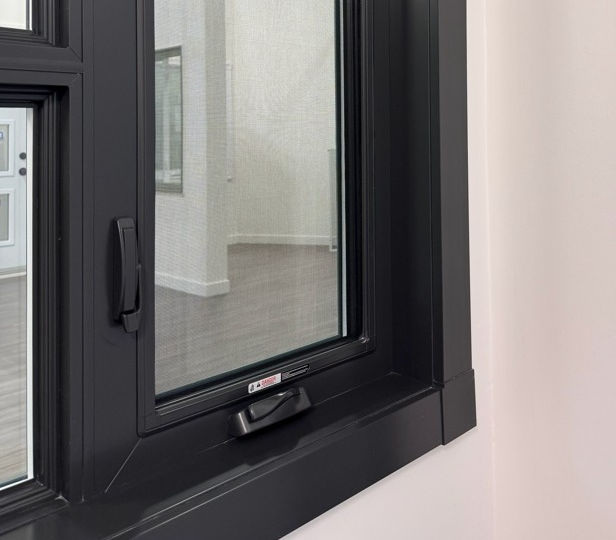

Black windows are a dark finish on a vinyl frame, and that finish absorbs more of the sun than white vinyl on the same wall. The colour is either carried in the vinyl or applied as an exterior laminate. It is not paint, and it does not change the glass.
Most houses that want the look use a black exterior and a white interior. From the street, the frame reads as trim against brick, stucco, or light siding. From the chair, the jamb stays light, so the opening does not turn into a dark border. You can finish locks and cranks to match the outside. You still choose the glass package on its own, the same way you do on a white window.
A frame that is hot to the hand on a sunny afternoon is a surface doing what a dark colour does. The heat that enters the room comes through the glass. The published installed prices are for the standard white finish. A colour or a laminate sits on top of that range as an upcharge, and the public calculator does not print a dollar amount for it.
Key Takeaways
- A black exterior is a factory vinyl finish, either through the profile or as a laminate, and paint is a different and weaker route.
- Dark vinyl absorbs more of the sun than white vinyl, so the outside of the frame runs hotter in direct light.
- That hotter surface isn’t the same as solar heat gain through the glass.
- A white interior with a black exterior is the combination that keeps the room light.
- Colour is an upcharge on the published installed ranges, and no public dollar figure is attached.
- Painting a white vinyl frame black can fail to bond and may void the manufacturer’s warranty.
What are black vinyl windows?
Window frame colours on vinyl are a finish, and black vinyl windows are that finish in its darkest form. The profile, chambers, hardware, and sealed glass unit are not different products just because the exterior is black. What changes is how much sun the outside surface retains, and how the opening looks against the wall.
White is the standard finish. Exterior colours and laminate finishes are available for operating styles and fixed units, and the interior can be a different colour from the exterior when the room calls for it. The colour either runs through the vinyl profile or is applied as an exterior laminate, so it is not a film of paint sitting on the surface. A factory finish is why the frame doesn’t need repainting after a few winters.
A whole elevation can stay one colour because the styles share one frame system and one colour range. Hung windows, sliders, and fixed units can sit beside a casement without a white frame next to a black one, unless you choose that split on purpose. Vinyl casement windows make the decision clear, because the crank, lock, and exterior colour are specified together, and the hinge side is chosen before the unit is built.
Does the colour run through the vinyl?
On some finishes it does; on others, the dark layer is only on the outside. Through-colour means the dark compound is in the vinyl, so a scratch still shows dark material rather than a white core. An exterior laminate is a bonded layer on the outside. The room side can stay white either way. Both are factory work. Neither is a can of paint applied after the window is in the wall.
The difference shows up on a cut end, a weep, or the edge of a sample, not on a brochure chip held under a lamp. If the dark layer is thin and the body of the profile is white, you are looking at a surface finish, and that finish should still be the laminate the factory bonds. Ask for the offcut. A salesperson describing “black vinyl” without a cut piece has not shown you which of the two routes you are buying.
Hold the sample on the wall, in the light that wall actually gets. A chip that looks neutral in a showroom can look blue, brown, or slightly warm on a south wall at 4 p.m., next to the soffit and the brick. Matching the exterior to the soffit or the trim, rather than to the siding, is how the frame usually reads from the street. A black window against black fascia looks continuous. A black window against beige siding looks like a drawn line. Either can be the right house. The sample is what decides it.
Before you leave the sample, check four things on the piece itself.
- The cut end. A dark core means the colour runs through the vinyl. A white core under a dark skin means a surface laminate.
- The exterior in afternoon sun. Hold it against the soffit, not against a white counter indoors.
- The room side. Confirm it is white, woodgrain, or black, and that you meant that choice.
- The hardware finish. The crank or the lock colour is a separate line from the frame colour.
Do black windows get hot in the sun?
Yes. Black windows get hot on the outside when the sun hits them because a dark surface absorbs more solar radiation than a white one. Black-framed windows pick up that reputation from the vinyl you can touch, not from a different kind of glass. Black window frames on a west wall in July are the ones you can’t miss. The same frames on a shaded north wall do not.
A National Research Council digest on building surfaces quantified the colour effect. A white surface absorbs about 40 percent of the solar irradiation that hits it, and dark green, brown, and black surfaces absorb about 90 percent. The absorbed energy must leave again. The surface temperature rises until convection to the outdoor air, long-wave radiation, and a smaller flow of heat into the material balance the incoming solar energy. In plain terms, the dark surface behaves as if the outdoor air were hotter than the thermometer says, for as long as the sun is on it.
The same digest recorded a plain demonstration on a southwest wall in Ottawa. Lightweight panels, black on one side and white on the other, were set so two of them showed the white side outdoors. Over one summer, the outer black surface reached 175 degrees F, about 79 degrees C, while the adjacent white panel reached 130 degrees F, about 54 degrees C. Those panels were not vinyl windows. They were a light exterior skin, which is the useful comparison. A vinyl frame doesn’t store heat the way a thick masonry wall does, so it reaches that sun-driven temperature faster than brick. It also sheds the heat faster once a cloud covers the sun. The frame gets hot while the sun is on it, but it doesn’t radiate heat into the evening.
Orientation changes the hour, not the fact of absorption. The digest found that east and west walls run hotter than south walls when everything else is equal, because their strongest sun arrives on a summer morning or late afternoon, when the air is already warm. A south wall gets its strongest sun near noon around mid-November, when the air is colder, so the surface peak is lower even though winter sun through the glass is often welcome. Darker laminates on a large south or west unit are the case Weather Pro’s own colour notes flag. The west unit in July is the one that is hot to the hand. The south unit on a bright January afternoon can feel warm, even when you’re dressed for the cold. Both are the surface. Neither reads the room.
“On a south or west wall in the afternoon, the outside of a dark frame is hot to the hand, and the white interior vinyl is not. Homeowners ask whether that heat is pouring into the room. I look at the glass on that elevation, because the frame colour is a surface finish and the sun that gets indoors comes through the glass,” says Chris Perry, Project Manager, Weather Pro.
Does a hot frame heat the room?
Very little, compared with the glass. Heat moves through a window on more than one path. Conduction can carry it through the solid frame, the sash, and the spacer. Passive solar gain comes through the glass. Air leakage carries it through a gap. The sun absorbed by an opaque frame is mostly handed back to the outdoor air by convection. Vinyl conducts far less heat than metal, and the frame borders the opening, not the opening itself. A hand on the exterior vinyl tells you the surface is hot. It does not tell you the room is gaining that heat.
The path that heats the room is the product’s solar heat gain coefficient, a fraction from 0 to 1 for the sun the window admits. Natural Resources Canada advises caution when that value sits above 0.45 on windows or sliding glass doors that face south or west, especially where there is more glass than wall. The caution is about the glass area and the coating. It is not about whether the frame is black. A white frame with a high solar heat gain coefficient on a large west opening will overheat a room. A black frame with a solar-control coating on the same opening will not, even though the vinyl outside is hotter to the touch.
At night the colour effect drops away. The digest found that the colour of a painted outer surface has no appreciable effect on the minimum surface temperature, because those paints share nearly the same long-wave emissivity once the sun is gone. That finding is about painted surfaces, not a lab test of a vinyl laminate. The practical point still holds for a window: a black frame is not colder on a clear night because it is black, and it does not warm the house after sunset. If a room is cold at the window in January, check the glass package, the seal, and air leaking around the frame. The exterior colour is unlikely to be the issue.
You can test the split without a meter. On a sunny afternoon, touch the exterior vinyl and then the interior jamb, if you can reach it with the sash closed. The outside of a dark frame will be warmer. The room-side vinyl, especially when it is white and shaded by the wall depth, will not match that heat. Then stand back and feel the air in the middle of the room. If that air is uncomfortable, look at how much glass faces west and whether anything shades it after 3 p.m. The frame colour will not explain a room that overheats an hour after the sun leaves the wall. The glass will.
When is a dark exterior the wrong call?
A dark exterior is the wrong call when the problem you are trying to solve is heat, a draft, or a failed seal. Colour will not tighten a sash, replace a fogged unit, or turn a single pane into a double pane. Condensation on the room side of the glass is a cold-glass and indoor-humidity problem. A black frame doesn’t cause it, and a black frame doesn’t cure it. Changing the colour and leaving a failed seal in place spends the visit on the wrong part.
It is also the wrong call when a large, unshaded west opening already overheats, and the quote still carries a high solar heat gain coefficient. Darkening the frame and leaving that glass in place spends the upcharge on the border while the sun keeps coming through the middle. Shade, a different coating, or a smaller share of west glass are the levers. The laminate is not one of them.
A dark finish on both sides is a poor call when the room needs the light the jamb reflects. A dark jamb against a dark wall can make a small opening feel smaller, and a north room that is already dim at 3 p.m. gets no help from a black interior. It is a poor call when the only route to the colour is paint on a white window that is already installed. And it is a poor call on a wall you have not seen a sample on. Order the finish from a piece held on that wall, in the afternoon, not from a photograph on a phone.
Should the black finish be outside or inside?
Put the black where you want the line to be seen, and keep the other side light unless the room is designed around the dark frame. Black exterior windows are the common request. The street sees the contrast, and the room keeps a white or off-white jamb. Black interior windows are the other job. The dark frame is part of the furniture, and the exterior can stay a quieter colour if the cladding does not want a black line.
A modern black-window exterior is usually that split: dark on the street, light in the room. The two sides do not have to match. A white interior with a coloured exterior is the combination most homeowners choose, and a woodgrain laminate on the room side is another option where the trim is already stained. If you use grilles, they should follow the side they face. A black exterior bar and a white interior bar look finished when the lights come on. One colour on both faces of the bar, on a two-tone window, reads as a mistake at dusk.
Hardware follows the same split. On a casement, the crank and lock are in the room, so a black exterior doesn’t force a black handle unless you ask for it. On a hung window, the locks and lifts are also interior parts. Specify them while the colour is being chosen. Changing a handle colour after the unit is built is a parts order, not a touch-up, and you’ll see a mismatched handle every time you open the window.
Coverings sit with the interior colour. A black interior frame fights a white shutter if the shutter is what you see all day. A white interior frame lets a Roman blind or a curtain read as fabric. If you rarely cover the glass, the interior colour is a line you see every morning. If you cover it from dusk on, the exterior colour is the one the street lives with.
How does a black frame compare with white vinyl?
People comparing black windows vs. white windows are comparing a finish and a surface temperature, not two kinds of window. The vinyl, glass choices, install, and how the unit is ordered are the same product family. White reflects more of the sun, shows dirt less, and is the price the calculator prints. Black absorbs more of the sun, draws a sharper line on the elevation, and shows dust, pollen, and dried rain sooner.
| Finish | Sun on the outside | What the room sees | What the calculator shows |
|---|---|---|---|
| White, standard | Less of the sun is absorbed | White jamb and sash | The published installed range |
| Black exterior, white interior | The outside surface absorbs more sun | A light room side | An upcharge, with no published dollar |
| Black on both sides | Both surfaces are dark in the sun | A darker opening | The same unpublished upcharge |
The cold-night row is the one people skip. Because colour has little effect on how cold a painted exterior gets after dark, a black frame does not hold the cold the way an aluminum frame conducts it. Winter comfort still comes from the glass, the edge of the sealed unit, and a sash that actually meets the weatherstripping. Summer comfort on a west wall comes from the coating and from shade. Switching the exterior back to white, and leaving a high solar-gain unit in place, does not fix an overheated room.
Cleaning is the everyday difference you will actually live with. A light rain that dries on white vinyl leaves a faint mark. The same rain on a dark laminate leaves a pale spot you can see from the sidewalk. Mild soap, water, and a soft cloth are the wash. Abrasive pads and solvent “restorers” are how a laminate gets dulled. None of that work restores a seal or a crank. If the complaint is that the sash will not close, colour is the wrong conversation, and washing the frame will not change the diagnosis.
Black against very dark cladding can disappear, so the contrast never shows. A lighter soffit or light trim makes the line readable. If the elevation is already charcoal, a black frame is a quiet choice. White frames on that same wall would be the higher contrast.
What does a dark finish add to the price?
Black windows cost more than the same white window, as the public list does not show an upcharge. White is the standard finish. Exterior colours and laminate finishes carry an upcharge on that standard. The figures below are budgeting examples for the installed window, including labour, sealing, and finishing, and they are the same across the provinces Weather Pro serves. They are not a quote. The exact number follows a measurement, and the colour line is extra on top of it.
The window replacement cost bands are easiest to read on a medium casement, the size most people use when they compare. That opening is $650 to $960 in double pane and $780 to $1,150 in triple pane. Across the operating styles, most double-pane jobs fall between $520 and $1,560, and most triple-pane jobs between $620 and $1,800. Picture and fixed windows start at $480 in double pane, and a large custom fixed unit in triple pane runs up to $2,520. Triple pane adds about 20 percent on the same window, with the step running from 9 percent to 50 percent on the largest sliders. Moving from a small opening to a large one adds roughly 25 to 45 percent, depending on style.
Those moves are larger than an unpublished colour upcharge, which is why the glass and the size belong on the quote before anyone debates black versus white. Eight medium double-pane casements, at the published band, are $5,200 to $7,680 before colour. That figure is the white price times eight. It does not include a guessed charge for the finish. A whole house of 15 to 20 medium double-pane operating windows budgets at $9,200 to $21,000 on the same basis, still before colour.
Putting black on the street elevation and leaving the lane white buys the look where it is seen. The factory still finishes those street units. They are fewer coloured units, not free units. If the lane or the kitchen side is in view, splitting the colour is a sightline choice. Walk that side before the order is split.
The installed price includes the unit built to the measured opening, removal, insulation and sealing, interior and exterior finishing, cleanup, and warranty registration, with the transferable lifetime warranty active from the day of installation. Rot, a resized opening, new interior trim on a full-frame job, and access equipment are quoted separately. Your colour choice doesn’t change that split. Retrofit or full frame is a condition-of-the-opening decision. You can order both in a dark finish. The colour doesn’t force you to tear out the old frame, and keeping the old frame doesn’t force the new unit to be white.
If a quote gives one number for black windows and never names double pane or triple pane, the colour is hiding the line that actually moves the price. Ask for the white price and the colour upcharge as separate lines, on each opening. Then you can see whether the difference is the finish or a quieter change in size, glass, or installation method. A single bundled number makes that impossible.
Can you paint vinyl windows black?
Painting vinyl windows black is a poor substitute for a factory finish. Vinyl is coloured through the material rather than coated, so it doesn’t need painting, and standard paint doesn’t bond reliably. Painting a vinyl frame can also void the manufacturer’s warranty. The best way to keep that conversation clean is to choose a factory colour or exterior laminate before the unit is built.
The pros and cons of vinyl windows include that limit in plain language. You cannot repaint the frame later the way you can repaint wood. That is a disadvantage if you like to change the exterior every decade. It is an advantage if you are tired of scraping a sill. A dark factory finish asks you to accept the colour for the life of the window, which is why the sample on the wall matters more than it does for white.
Paint fails in a few familiar ways. It crawls on slick vinyl, chalks, and cracks where the profile moves a little with temperature. A dark paint shows every crack as a light line, and sun on that surface makes the failure easier to see. Masking a white window and spraying it in the driveway does not reproduce a bonded laminate, and it does not put the colour through the vinyl.
If the windows are already white and still sound, leave them. Spend the money on the glass, or on the openings that actually leak. If the windows are being replaced, order the colour. Do not accept a line that says the crew will paint the new vinyl on site to avoid the upcharge. That trades a factory finish for a coating the warranty may not stand behind, and the touch-up will not match once the sun has been on it for a summer.
Which walls heat dark vinyl the most?
The hottest dark vinyl windows sit on unshaded east and west walls in summer, when the strong sun and the warm air arrive together. South walls take a hard sun too, and in the cold months that sun lands while the air is still low, so the frame can feel warm on a day when you are dressed for winter. North walls barely see this problem. A porch roof, a deep eave, or a tree cuts it on any side, but an eave that shades the frame at noon in June often misses a west frame at 5 p.m., when the sun is low. A dark laminate on a large west opening with no overhang is a unit to be deliberate about.
The glass area and the frame colour share that wall, and they are still two decisions. A fixed unit has the slimmest border and the largest sheet of glass, so the sun entering the room is almost entirely a glass question, while the vinyl that is hot to the touch is a narrow band around it. Picture windows make that split obvious, because nothing opens and the frame can be slimmer than on an operating unit. Darker laminates still absorb more solar heat on a large south or west unit. They do not replace a decision about the coating.
A winter that keeps breaking into milder, sunny days is a different load from a winter that stays cold. At Calgary International Airport, the 1991 to 2020 normal is 4,993.7 heating degree-days below 18 degrees C. The January daily maximum averages -1.5 degrees C; there are 42.0 days a year with a wind chill below -20, and 87.4 days with a maximum above 20 degrees C.
The frame on a south wall can sit in the sun on those milder January afternoons. That is why replacement windows in Calgary are specified based on the glass and the elevation when the exterior is black. The colour doesn’t reduce the heating load. It only changes how warm the vinyl feels while the sun is on it.
Farther from the foothills, the cold lasts longer. Edmonton International Airport’s normal for the same years is 5,697.1 heating degree-days below 18 degrees C. The January daily maximum averages -6.5 degrees C; the station records 67.4 days with a wind chill below -20, and 89.8 days with a maximum above 20 degrees C. The summer counts are close. A dark frame’s afternoon heat is a similar summer event in both places, while the heating season is the longer one here.
The longer heating season is why a windows and doors company in Edmonton treats a black exterior as a finish and puts the energy choice on the glass, with triple pane used most often on north and west elevations. One winter is interrupted by milder days. The other piles up more heating degree-days and more deep wind-chill days.
None of that makes black a cold-climate problem or a privilege of a milder winter. You don’t buy the colour to save fuel, and you don’t refuse it because the airport records a long heating season. You buy it where the line belongs, and you keep shade and the coating in the conversation on the west wall. A black frame on the north side of either city is a design choice with almost no summer heat penalty, and it still does nothing to stop heat leaving through a weak unit.
What should the glass do when the frame is dark?
The glass should do the energy work the frame cannot. Weather Pro’s standard package is double pane with a low-E coating and argon. Triple pane adds a third pane and a second sealed cavity. On the Prairies, it is the package most often specified for north- and west-facing elevations, where heat loss matters more than collecting winter sun. A dark exterior does not move an opening from one package to the other. A north window doesn’t gain much heat in the vinyl, and it still loses heat if the unit is a weak double pane. A west window can have a hot black frame and still overheat the room if too much sun passes through a large sheet of glass.
Window glass options includе pane count, coating, and gas. Alongside a colour decision, the split is in the job. A low-E coating reduces heat loss in winter and heat gain in summer. It is not a tint you choose so the glass matches a black frame, and a dark frame is not a substitute for the coating. If one room overheats, ask which behaviour that coating has. The public pages name low-E as part of the standard package and do not publish a solar heat gain number for each elevation, so the quote has to say what is on the west units.
Vinyl replacement windows ordered as one house can carry one colour range across every style. Weather Pro builds those units factory-direct and installs them with its own crews, so the colour, the glass, and the hinge side are settled before the window is made.
A few checks belong on the same sheet as the colour.
- Elevation. North and west for heat loss. West and south for afternoon sun on the glass and on the dark vinyl.
- Shade. An eave that covers the frame at noon in June does not cover a west frame at 5 p.m.
- Interior colour. White on the room side, unless the room is designed around the dark jamb.
- Sample on the wall. The laminate in the afternoon, next to the soffit, it has to live with.
- Quote lines. Style, size, double or triple pane, exterior colour, interior colour, and hardware, each named.
A dark frame is a finish, and the glass still sets the heat
A dark frame is a finish you can see, and a surface that runs hotter in the sun than white vinyl. Black windows make that difference on the outside of the profile. They don’t rewrite the heating bill, and they don’t cool a west room. The glass, the elevation, and the shade still decide the heat indoors. Colour defines the line on the wall and how warm the exterior vinyl feels to the touch.
Colour will not seal a draft, clear a fogged unit, or stand in for the coating. Paint on white vinyl is not a factory black, and a black interior is a design choice, not a requirement that comes with a black exterior. On a milder January afternoon, the south frame can feel warm while the air is cold. On a longer winter, the same finish is still only a finish.
Order the finish from the factory, on the side of the window where you want it, and leave paint out of the plan. Hold a sample on the wall you are actually changing. If the west rooms already overheat, settle the glass and the shade before you spend the upcharge on a darker frame. Once the openings, colour split, and glass are decided, a free quote after a measurement prices the upcharge instead of guessing it.
Frequently Asked Questions
Are black windows a good idea?
When the house wants a dark line, and the glass is already right for each elevation, yes. They sharpen the trim against light cladding, and a white interior keeps the room from going dark. They are a weak idea if the goal is a lower heating bill, a cooler west room, or avoiding a failed seal.
Are black windows still in style in 2026?
The look is still specified because it contrasts with brick, stucco, and light siding, not because a calendar year made it mandatory. Choose it if it belongs with the soffit, the door, and the cladding you already have. Skip it if you are buying it only because a photograph used it.
Do black windows get hotter than white ones?
The outside does. A dark surface absorbs more solar radiation, so the exterior vinyl runs hotter in direct sun than white vinyl beside it. The room does not automatically get hotter. Heat through the opening is mainly the glass and its solar heat gain coefficient.
Can windows be black outside and white inside?
Yes. That split is standard: a dark exterior and a white interior. The colour runs through the profile or sits as an exterior laminate. Specify it before the unit is built; don’t paint it on after installation.
Are black windows expensive?
They cost more than the same white window because colour and laminate are an upcharge. A medium double-pane casement, for example, budgets at $650 to $960 installed in the standard white finish. No public dollar amount is listed for the colour itself, and the exact price depends on measurements.
Can you paint vinyl windows black?
You can try, but it is a bad plan. Standard paint doesn’t bond reliably to vinyl, and painting a frame can void the manufacturer’s warranty. A factory colour or exterior laminate is meant to stay black.
Are black windows fading out?
Aesthetically, they are still chosen for contrast with light cladding. As a material, a factory colour or laminate is different from paint that chalks and peels. If an old painted frame is powdering, that’s coating wear, not proof that a new factory finish will do the same.
Does a black frame warm the house in winter?
No. After the sun leaves the wall, colour does little to affect how cold the exterior surface gets. Winter sun through the glass can warm a room. The black vinyl warming under your hand on a January afternoon is the surface, not a heater for the house.