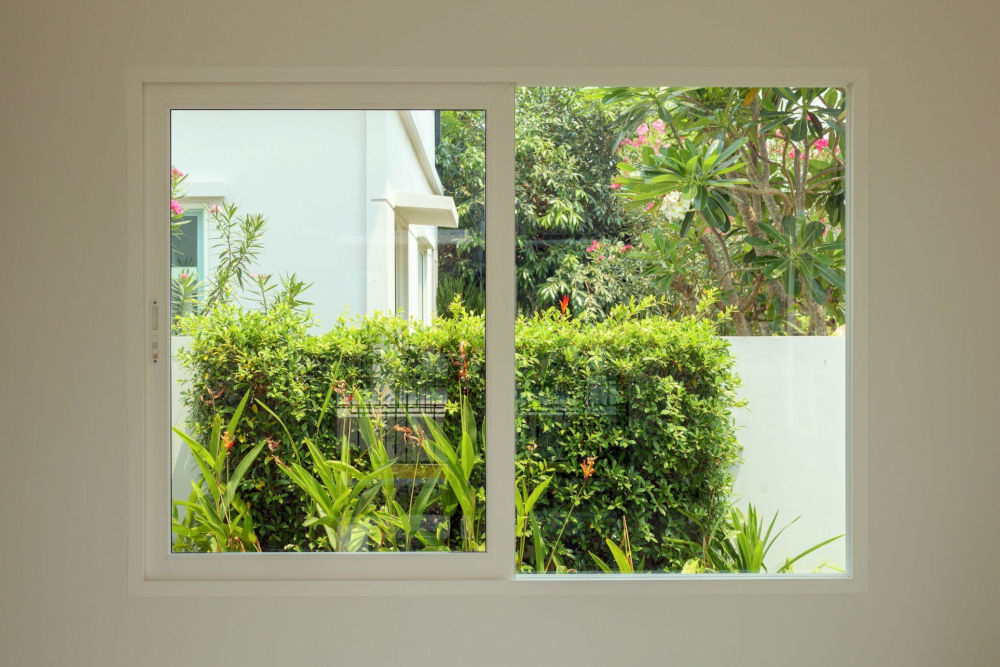

Single slider vs double slider windows comes down to which sash moves. A single slider has one sash that slides and one that stays fixed. A double slider has two sashes that both slide. Choose a single slider when one side of the opening is enough, and the opening isn’t wide. Pick the double slider when you need air from either end, or the opening is already large enough that a second operating sash is what the wall needs.
Both styles move sideways inside the frame. Nothing swings into a walkway, a deck, or a narrow side yard. A single slider opens to at most half the frame width. A double slider can open from either side, or both sashes can move toward the centre, so air enters at both ends. The glass package is a separate choice. Double pane with a low-E coating and argon is the standard. Triple pane adds a third pane and a second sealed cavity when you want lower heat loss and less outside noise. Sash count does not replace that glass decision.
This article covers how each slider opens, where each one belongs, how ventilation and cleaning work, what a bedroom escape opening must clear, what the installed budget ranges are, and what a written quote should include before the unit is built.
Key Takeaways
- A single slider moves one sash beside a fixed pane. A double slider moves both sashes in the same frame.
- A single slider opens to at most half the frame width. A second slider changes which end you can open. It does not, by itself, turn the whole frame into a clear hole.
- Use a single slider for bedrooms and secondary openings, and anywhere a swinging sash would hit a walkway, a deck, or a side yard.
- Use a double slider on a wide opening that still has to vent, or when you want air at both ends of the same window.
- Openings often wider than 72 inches belong on an end vent slider, with a fixed centre and an operating sash at each end, priced on site.
- Cleaning is tilt-in. On a single slider, the promise covers the operating sash. On a double slider, both sashes tilt in. A tilt-in wash is not the bedroom escape opening.
- Installed budgeting ranges start near $540 for a small single slider in double pane and run to $1,590 for a large double slider in triple pane. The exact price follows a free in-home measurement.
How single slider vs double slider windows differ
Weather Pro builds both styles as factory-direct vinyl replacement windows to the measured opening. There is no stock slider size for an existing Canadian house, so we decide whether you need one moving sash or two at measurement, before we weld the frame. Changing that choice after the unit is built means rebuilding it.
One operating sash and one fixed pane
Single slider windows put two sashes side by side. One rides the track. The other is fixed, which is why this style ranks among the most economical operating units Weather Pro builds. Nothing projects past the wall. Handing is permanent: name the moving side on site, or the sash you actually use can end up behind the dresser. The seal is contact in the track, a different joint from a casement that compresses when the crank pulls the sash shut.
Two operating sashes in the same frame
Double slider windows have no fixed sash in a two-lite unit. You can open either side, or draw both sashes toward the centre. Both tilt in. The price step is modest on small and medium openings and larger on big ones, because the second operating sash needs more reinforcement.
“On the measurement, I ask which side of the room you actually open. One side, and a hole that is not wide, is a single slider. Air at both ends, or an opening that is already oversized, is both sashes, written down before the frame is built,” says Chris Perry, Project Manager at Weather Pro.
Prices in the comparison are installed budgeting ranges, from the smallest double-pane unit to the largest triple-pane unit. They are not a quote.
| Point | Single slider | Double slider |
|---|---|---|
| Operable sashes | One | Two |
| Fixed sash | One | None in a two-sash unit |
| Projects past the wall | No | No |
| Opens to | At most half the frame width | Either end, or both ends toward the centre |
| Tilt-in cleaning | Operating sash | Both sashes |
| Usual fit | Bedrooms and secondary openings | Wide openings that still need to vent |
| Double pane, installed | $540 to $1,140 | $590 to $1,300 |
| Triple pane, installed | $650 to $1,370 | $700 to $1,590 |
Where a single slider belongs
A single slider is the usual Weather Pro choice for bedrooms and other secondary rooms, for places where a swinging sash would be in the way, and for wide, low openings that should still look related to hung windows on the same house. Sliders read wider than they are tall. A tall, narrow opening often calls for a hung window or a casement.
Exterior clearance is the other common case. Over a walkway, along a deck, or in a side yard tight to the fence, a casement or an awning needs room outside the wall. A slider does not. A sash that hits a downspout, a meter, or a railing is a failed window even when the glass specification is right. Don’t use a single slider for a hole that is mainly a view. A picture window starts lower because it has no operator. If the room still needs air, pair fixed glass with an operator, or step up to a double slider or an end vent.
Where a double slider, or an end vent, belongs
A double slider is the usual choice when the opening is oversized and still has to open, when the room needs air at both ends of one window, and when nothing can swing out. Weather Pro’s own description is direct: both sashes open so you can ventilate from either side, and the price step is modest until the opening is large.
That “large” is the moment to look at a third configuration. An end vent slider is one frame with a fixed centre and a sliding sash at each end. Weather Pro uses it for wide openings, often wider than 72 inches, where a single or double slider would need an oversized sash. The centre carries the view. The ends vent and tilt in. Nothing projects past the wall. The split is drawn for that wall, so we price an end vent per configuration, as we do for bay, bow, and specialty shapes.
Use the double slider while the width is still a two-lite opening, and both lites should move. Use the end vent when those two lites would be clumsy. A few room tests keep the choice honest:
- A bedroom of ordinary width, with the bed on one side, usually wants the single slider, with the operating sash on the open side of the room.
- A wide living-room or dining opening that you crack in mild weather usually wants the double slider, so you are not stuck venting only the left or only the right.
- A hole often wider than 72 inches, especially one that used to be a picture window with operators beside it, usually wants the end vent.
- A walkway, deck, or tight side yard rules out a crank sash for all three. It does not, by itself, pick single over double.
Ventilation, tracks, and the half-width limit
Slider window ventilation is horizontal. On a single slider, the operating sash opens to at most half the frame width. You can stop partway. You cannot slide that sash out of the frame and get a hole the size of the whole unit.
A double slider feels like more air because you can choose the end, and because both sashes can sit toward the centre, opening a gap at each jamb. Weather Pro calls that wider ventilation: air at more than one place along the same head and sill. Two sashes still occupy the frame, so the clear area does not automatically double. Measure the gap you will actually live with.
Grit in the sill track makes a sound sash feel failed. Vacuum the track and wipe the meeting rail as part of ordinary care. A sash off its roller, or a lock that no longer meets, is a service visit. The seal is contact along the track, not a casement’s compression on four sides, so on an exposed wall the glass package and the install matter more than one sash versus two. Weather Pro certifies the windows ENERGY STAR for the Canadian climate zones where they are sold. Ask for that whole-window rating on the unit and the size being built.
Horizontal sliding windows also show up as gliders, or as XO (one operating sash, one fixed) and XX (both move). If a quote uses only those letters, have them translated into “left fixed” or “both move” before you sign.
Cleaning from inside, without counting the tilt as the opening
Tilt-in is a cleaning feature, and the two styles don’t offer it the same way. On a single slider, the operating sash tilts inward so you can wash the outside of that glass from the room. The product description does not say the fixed sash tilts. Plan on the fixed pane as glass you reach from outside, or that you reach across when the operating sash is open, and confirm that path at measurement if the window is on a second storey.
On a double slider, both sashes tilt in. That is why an upper floor often justifies the extra sash, even when you don’t need air at both ends. You wash the far side of the window from the room. You do not remove the sash to do it. Tilt-in is a wash position, not the ventilating opening and not the escape opening.
Screens sit outside, because the sash stays in the wall. The screen should release from inside without a key or a tool if this opening is also the bedroom escape window. Say in the quote if the only reason for a double slider is that you cannot reach the outside glass. A single slider on the ground floor and a double slider over the stair is a normal mix.
Bedroom escape: the clear hole, not the frame size
A slider can be a bedroom escape window. It can do that job only when the unobstructed opening, with the sash fully slid open, is large enough. The City of Lethbridge bulletin on the National Building Code of Canada 2019 Alberta Edition, Part 9, is explicit about sliders. Horizontal and vertical sliders can satisfy the bedroom-window article when the opening passes the test, and you should measure the unobstructed opening when the window is fully open. Flipping the sash into the room for cleaning takes several steps. That is not a normal opening, and it is not the hole you measure.
The same bulletin sets the size test for unsprinklered bedroom windows: an unobstructed opening of at least 0.35 square metres, with no dimension less than 380 mm (15 in), held open without extra props. Measure between sash, jamb, sill, and hardware. A 380 mm by 380 mm hole fails the area rule. If one side is exactly 380 mm, the other has to reach about 921 mm before the area is met. Provinces adopt the national code in their own editions. A sprinklered suite can sit outside this sentence. Confirm the rule with the authority having jurisdiction before you treat one Alberta bulletin as the rule on your street.
On a single slider, only the operating side can become that hole, and it opens to at most half the frame width. A double slider lets you open either end. It does not automatically double the clear area. Weather Pro does not publish a clear-opening chart by style, so the estimator must set the fully open hole based on the rule that applies to that house.
“Tilt-in is for washing the glass. The escape opening is the hole you get when you slide the sash fully open, remove the screen, and remove nothing else. If that hole is too small, a second sliding sash does not fix it,” says Chris Perry, Project Manager at Weather Pro.
Upper floors add a second problem: sliders meet more issues than crank windows. A sash that can be pushed further open once it is cracked is a fall risk for children. Codes answer that with a guard or with a limiter. In a decision published on 29 November 2024, British Columbia’s Building Code Appeal Board restated that the minimum unobstructed opening specified for escape windows must be achievable using only the normal window operating procedure. In that case, the board held that a device limiting the clear opening to not more than 100 mm could satisfy the guard rule and still fail the escape rule. The same decision notes that Alberta has used a separate variance on a related question, and that the variance does not apply in British Columbia.
The escape window and a child-safety stop can be different windows. They are a poor pair on the same sash when the full opening needs a release a guest has never seen. A like-for-like replacement in the same hole may not be a new-bedroom review. The local building official draws that line. The Lethbridge bulletin also recommends, without a hard maximum, that escape sills sit no higher than 1.5 m (5 ft) above the floor, and that screens and bars release from inside without a key, a tool, or special knowledge. A slider frozen shut in January is not an escape window.
What single slider and double slider windows cost
Weather Pro publishes installed budgeting ranges on its window replacement cost page. The figures include the unit built to the measured opening, removal, insulation and sealing, interior and exterior finishing, cleanup, haul-away, and warranty registration. They are examples for planning. The exact price follows a free in-home measurement. List prices are the same across the provinces Weather Pro serves. What usually moves the number is the specification, especially double pane versus triple pane, not the city on the invoice.
A single slider window costs $540 to $1,370 installed, from the smallest double-pane opening to the largest triple-pane opening. Double slider window cost on the same basis runs $590 to $1,590. Sliders, like single-hung windows, are among the most economical operating styles. Single-hung starts at $520 for a small double-pane unit. The gap widens on a large triple-pane double slider, listed at $1,260 to $1,590. The pricing page puts triple pane at about 20 percent more than the same window, with a spread from about 9 percent to as much as 50 percent on the largest sliders. Use the band below, then let the measurement replace it.
Size bands match the calculator. Small is up to 24 by 36 inches. Medium is up to 36 by 60 inches. Large is over 36 by 60 inches. Read a slider by width as well as height.
| Size | Single, double pane | Single, triple pane | Double, double pane | Double, triple pane |
|---|---|---|---|---|
| Small, up to 24 by 36 in | $540 to $820 | $650 to $890 | $590 to $880 | $700 to $1,060 |
| Medium, up to 36 by 60 in | $640 to $960 | $760 to $1,150 | $700 to $1,050 | $850 to $1,250 |
| Large, over 36 by 60 in | $740 to $1,140 | $890 to $1,370 | $840 to $1,300 | $1,260 to $1,590 |
White is the standard finish. Exterior colour and interior laminate, including a white interior with a coloured exterior, are an upcharge with no published dollar amount. Darker laminates absorb more solar heat on large south and west units. Most people match the frame to the soffit or the trim, because the frame reads as trim from the street.
Quoted separately when they apply: rot or structural repair, a resized opening, new interior trim on a full-frame job, and access equipment. A retrofit keeps a sound, square frame. A full frame goes back to the rough opening when the old frame is rotten, or the opening has shifted. That choice changes the labour line. It does not change which sash should move. In-house crews complete most replacement projects in one day.
Weather Pro’s product notes say a quality vinyl window typically lasts 25 years or more. The frame usually outlives the sealed glass, so the first sign of age is often a fogged pane. A transferable lifetime warranty covers manufacturing defects. A dirty track is care, not a warranty claim.
What the quote should name before the unit is built
Two sliders with the same outside width can be different products. If the paperwork says only “slider” or only “vinyl window,” you cannot tell which sash moves, which glass is in it, or whether the old frame stays. Ask for these items in writing. Each one changes either the way you live with the window or the price.
- Which sash operates. One side, both sides, or an end-vent split, and which end is fixed.
- The measured size. Width and height of the opening being built, not a catalogue call size.
- Glass package. Double-pane or triple-pane, low-E, and argon, written per opening rather than as a house-wide slogan.
- Frame path. Retrofit into a sound frame, or full frame back to the rough opening.
- Finish. White, or the exterior colour and interior laminate, noted as an upcharge if it is not white.
- Hardware that limits the opening. Any child-safety stop, named separately from the escape window if this is a bedroom.
- What is excluded. Rot repair, a resized opening, new interior trim, and access equipment, each as its own line if it applies.
A few mistakes show up after the first winter, and they were all decisions available on quote day.
- Ordering a double slider for every opening. In a small bedroom, you pay for a second sash you will not use.
- Ordering a single slider for a very wide hole. That width was an end-vent conversation.
- Treating tilt-in as the escape opening, or assuming two sashes means the clear hole is twice as big.
- Comparing a single-slider double-pane price with a double-slider triple-pane price and calling the gap the cost of a double slider.
- Putting a limiter on the only bedroom escape sash.
- Ignoring the install. Contact seals and a filled gap around the frame decide whether the rating survives a windy wall.
The visit is measurement, a product demonstration, and a written estimate. Bring a note on which windows you actually open, which ones you cannot reach to wash, and which bedroom you would use if the hall was blocked. Those three facts determine the sash count.
Match the moving sash to the opening you already have
A single slider is the right window when one side of a modest opening has to move, the other side can stay glass, and a swinging sash would be in the way. A double slider is the right window when the opening is wide, and you want to choose the end that opens, or vent both ends, and you want both sashes to tilt in for cleaning. Past the width where two operating lites get clumsy, often beyond 72 inches, an end vent keeps a fixed centre and puts the moving glass at the ends.
The escape test, a child-safety stop, and the glass package sit beside that choice. Measure the fully open hole if the room is a bedroom. Keep a limiter off the only escape sash unless local rules say that hardware still counts as normal operation. Specify double-pane or triple-pane on purpose. Use the size band as a budget and the in-home measurement as the price.
If you want the opening measured and the sash count written down before anything is built, get a free in-home estimate. Walk the outside of the wall with the estimator. The fence, the deck, and the sill height will matter more than the style name on the truck.
Frequently Asked Questions
What is the difference between a single slider and a double slider window?
A single slider has one sash that slides horizontally and one fixed sash. A double slider has two sashes that both slide, so the window can open from either end or from both ends toward the centre. Both styles stay inside the wall when they are open. The single slider’s operating sash opens to at most half the frame width. The double slider’s advantage is which side you can open, and that both sashes tilt in for cleaning, not a second storey of glass.
Do double slider windows provide more ventilation than single sliders?
They provide more control over where the air enters. You can open one end or draw both sashes toward the middle. Weather Pro describes that as wider ventilation. The two moving panels still take up space in the frame, so don’t budget the room’s airflow as if the entire unit disappeared. If you need a hole closer to the full width of the opening, a casement swings the sash out of the way. It needs exterior clearance; a slider does not.
Are sliders or double-hung windows more expensive?
On Weather Pro’s installed budgeting ranges, a small single-hung window in double pane starts at $520, and a small single slider starts at $540. A double-hung window runs $570 to $1,160 in double pane and $680 to $1,390 in triple pane. A double slider runs $590 to $1,300 in double pane and $700 to $1,590 in triple pane. Hung windows aren’t always cheaper, and sliders aren’t always cheaper. Compare the same size band and the same glass. Hung windows travel vertically. Sliders travel horizontally and suit openings that are wider than they are tall.
Are double hung or slider windows better for a replacement?
Use the opening you have, not a house-wide winner. A tall, narrow hole you want to tilt in from both sashes calls for a double-hung configuration. A wide, low hole, or any hole where a swinging sash would hit a deck or a walkway, is a slider configuration. Within sliders, one operating sash fits ordinary bedrooms. Two operating sashes fit wide openings and upper-floor glass you need to wash from inside. Energy performance still depends on the rated unit and the install, not on which name sounds more complete.
Can a horizontal slider be a bedroom escape window?
Yes, if the clear opening in the fully slid-open position meets the rule that applies to that house, and if you can open it from inside without a key, a tool, or special knowledge, and without removing the sash. Under the Alberta edition described by the City of Lethbridge, unsprinklered bedroom windows are checked against 0.35 square metres with no dimension under 380 mm. A tilt-in wash does not count. A single slider can fail that test even when the frame looks large, because only the operating portion opens, and it opens to at most half the frame width. Confirm the local edition before you order.
How much does a single slider window cost in Canada?
Weather Pro’s installed budget range for a single slider is $540 to $1,140 for double pane and $650 to $1,370 for triple pane, by size. A small double-pane unit is $540 to $820. A large triple-pane unit is $890 to $1,370. Those figures include the window, labour, sealing, finishing, cleanup, and warranty registration. They are planning numbers. Colour, a rotten frame, a resized opening, and access equipment are extra when applicable. They use the same list across provinces. Your number comes from a measurement.
What is an end vent slider window?
An end vent slider is one frame with a fixed pane in the centre and a sliding sash at each end. Weather Pro uses it on wide openings, often wider than 72 inches, where a single or double slider would need an oversized sash. The ends tilt in for cleaning. The unit is priced per configuration because the split between the centre and the ends is determined by the wall. It is the right question when the opening is too wide for a simple two-lite slider, and you still want ventilation without a crank sash outside the wall.
Can you clean a single slider from inside if one sash is fixed?
You can tilt the operating sash in and wash the outside of that glass from the room. Weather Pro’s single-slider description attaches tilt-in to the operating sash, not to the fixed sash. A double slider tilts both sashes in, which is why it is the cleaner choice on a second storey even when you only open one side day to day. If the fixed pane on a single slider is out of reach from the ground, say so before the handing is locked in.