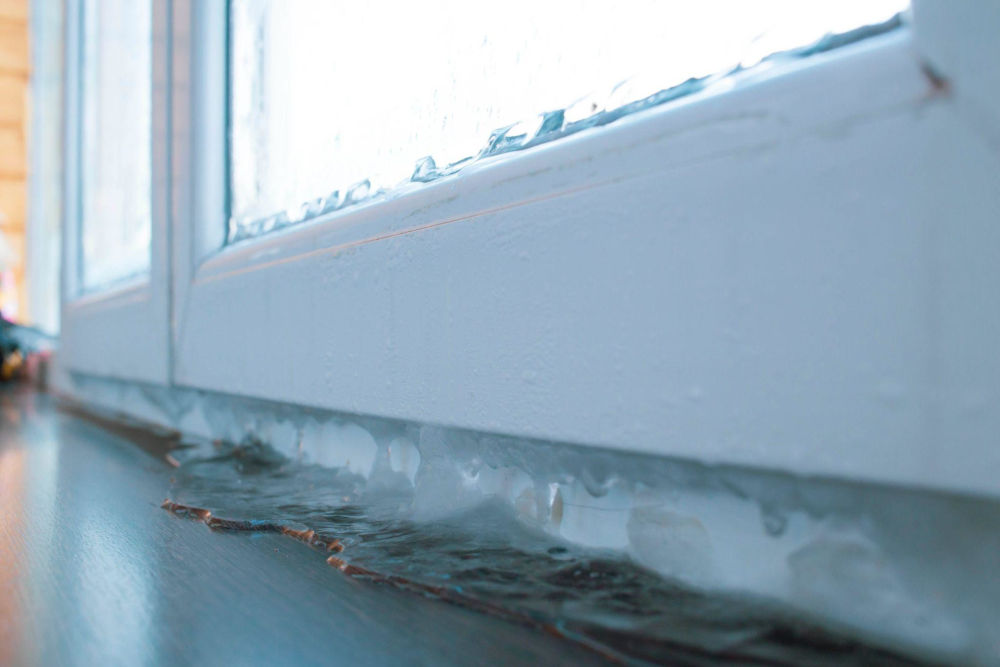

Window condensation freezing happens when moisture in indoor air meets a glass surface cold enough to first condense into liquid, then turn to frost or ice on the room-facing pane. It is one of the most common winter complaints in Edmonton, and one of the most frequently misread.
Most homeowners see ice on the inside of a window and conclude the window has failed. Sometimes that is correct. More often the ice is reporting on two things at once: how much water vapour is in the air, and how cold the glass surface gets. Those are different problems with different costs, and the article that tells you to simply turn down the humidifier gives you only half the picture.
This article explains the physics, corrects widely circulated advice that conflicts with Canadian health guidance, shows how to tell interior frost apart from a failed seal and exterior condensation, and lays out what to check before deciding whether replacement is warranted.
Key Takeaways
- Interior frost is a physics result, not automatically a product defect. It appears when the room-facing glass surface falls below the frost point of the air touching it. Two variables control that: how much moisture is in the air, and how cold the glass gets.
- The low humidity numbers you see online are ceilings, not targets. Figures like 15 or 20 percent relative humidity describe the maximum a poorly performing window can tolerate before frosting. Health Canada recommends keeping indoor relative humidity between 30 and 55 percent. Living at 15 percent to protect a window is treating the symptom at the expense of the occupants.
- That conflict is itself the diagnosis. If your house has to run below Health Canada’s recommended range to keep the windows clear, the glazing is the constraint. That is the single most useful conclusion in this article.
- Location tells you which problem you have. Frost you can wipe off the room-facing surface is a humidity and glazing question. Haze between the panes that never clears is a failed seal. Condensation on the outdoor-facing surface usually means the window is performing well.
- Glass is the coldest surface in the room, and that is why it shows first. Walls have insulation behind them, and ceilings have attic space. Glass has comparatively little thermal resistance, so it reaches the dew point before anything else does.
- Freeze and thaw cycles do the actual damage. Ice melts as the room warms, the meltwater runs to the sill, and over a winter or two that cycle stains paint, swells wood and degrades the gaskets around the sash.
- Raising the glass surface temperature is the durable fix. Triple glazing with a low-emissivity coating and an inert gas fill keeps the interior surface closer to room temperature, raising the humidity level the house can carry before frost appears.
How Condensation Freezing Works
Dew Point and Frost Point
Air holds water vapour. The dew point is the temperature at which that vapour begins condensing into liquid on a surface. The frost point is the temperature at which it deposits directly as ice without passing through the liquid stage. Both rise as the air gets more humid, which means a humid room produces condensation on surfaces that are only moderately cold, while a dry room needs a genuinely cold surface to produce anything at all.
Window glass is almost always the coldest exposed surface in a heated room. Walls have insulation, ceilings have attic space above them, and glass has comparatively little thermal resistance between the indoor air and the cold outside. That is why condensation shows on windows first and why windows are a useful early indicator of a moisture problem elsewhere in the house.
Why the Glass Gets So Cold
The interior surface of a window sits below room temperature by an amount that scales with the assembly U-factor and with the difference between indoor and outdoor temperature. A single-glazed window has almost no thermal resistance, so on a minus-18 night with the thermostat at 21, the room-facing surface can fall several degrees below freezing. An older double-glazed unit with no coating and an air fill performs better, but not dramatically. A current triple-glazed unit with a low-emissivity coating and an argon fill keeps that surface much closer to room temperature.
This is the whole mechanism in one sentence: halve the assembly U-factor and you roughly halve the drop, which raises the humidity level the house can carry before the glass reaches the frost point. Everything else in this article follows from that relationship.
Why the Pattern Appears Where It Does
Frost is rarely uniform across a pane, and where it forms tells you a lot. It concentrates at the bottom corners because cold air pools near the floor and chills the lower glass most. It forms along the frame edges because the spacer bar and the frame conduct heat away from the glass perimeter, making the edge colder than the centre. Heavy frost at the edges with a clear centre points to the spacer and the frame rather than at the glazing itself, which matters because a glass-only replacement will not change it.
From Liquid to Ice and Back
On a very cold night, vapour can deposit straight onto the glass as frost crystals. On a moderately cold night, you may see liquid condensation in the evening that freezes as the glass cools further overnight. By morning, ice forms on the interior face. As the room warms, the ice melts, runs down the glass and pools on the sill, leaving water marks and mineral deposits behind.
That daily cycle causes the damage, not the ice itself. Water sitting on a wood sill or against the bottom of a frame, freezing and thawing repeatedly through a winter, stains paint, swells wood and breaks down the compression gaskets between the sash and the frame. The frost is cosmetic. The meltwater is not.
The Humidity Advice That Needs Correcting
A figure circulating widely in advice on this subject is that you should keep indoor relative humidity at or below 15 percent when the outdoor temperature falls under minus 20, and at or below 20 percent between minus 10 and minus 20. Those numbers come from building science; they are arithmetically correct, and presenting them as targets is a mistake. Health Canada’s guidance on indoor relative humidity recommends a range of 30 to 55 percent, and sustained operation well below that range brings its own consequences: dry airways, irritated eyes and skin, static, and shrinkage in wood flooring and furniture.
The distinction is between a ceiling and a target. Those low figures describe the maximum humidity a window with poor thermal performance can tolerate before frost appears. They do not describe a healthy indoor environment. Running a house at 15 percent relative humidity through an Edmonton January to keep a window clear protects the glass at the expense of the people in the room.
Read the conflict as information, because it is the most useful diagnostic in this entire subject. If your house has to sit below the range Health Canada recommends in order to keep the windows free of frost, the glazing is the limiting component. That is not a household management failure, and a hygrometer will not solve it. It is a specification problem, and it is the point at which replacing the glazing stops being optional and starts being the actual answer.
The reverse is equally useful. If your windows frost at 45 percent relative humidity and clear at 32 percent, the glazing is working within a normal range, and the humidity was the variable. That house does not need new windows. It needs a hygrometer, working exhaust fans and a correctly set ventilation system.
Three Places Moisture Appears, and What Each One Means
First, figure out which of the three situations you actually have. They look similar from across the room, and they mean completely different things.
On the room-facing surface. You can touch it and wipe it away. This is condensation or frost formed from indoor air on cold glass, and it depends on humidity and glazing performance. It varies with the weather and with how the room is used.
Between the panes. You cannot reach it from either side, and it does not clear on a mild day. The perimeter seal of the sealed unit has failed, humid air has entered the cavity, and the inert gas fill has escaped. The unit has lost most of its insulating value, and the sealed unit or the window has to be replaced.
On the outdoor-facing surface. Dew or light frost on the outside of the outer pane, usually on a clear autumn or spring morning. This surprises people, and it is generally good news. It happens when the outer pane is cold because so little heat is escaping through the assembly to warm it, which is precisely what a high-performance window is supposed to do. It clears as the sun comes up, indicating the glazing is working rather than failing.
Why Edmonton Homes See This More Than Most
Edmonton has a longer, colder heating season than most Canadian cities of comparable size, with stretches at minus 25 to minus 35 where the glass surface temperature in any window is pushed to its limit. At the same time, the heating system dries the air continuously while cooking, bathing, laundry, houseplants, and simply breathing add moisture back. The result is a house where the moisture balance shifts through the day and the coldest hours arrive when nobody is awake to notice. For windows in Edmonton, the practical consequence is that a glazing package adequate in a milder city can sit right at the frost threshold here.
Newer construction complicates it rather than solving it. A tightly built envelope holds moisture in far more effectively than a draughty older house did, which is both an energy benefit and a humidity liability. A well-sealed home without functioning mechanical ventilation can carry higher indoor humidity than an older leaky one, which is why frost problems appear in houses whose owners assumed newer meant immune.
Heat recovery ventilators are the intended answer, and they are common in Edmonton construction. They are also commonly left on a setting chosen in September and never revisited. A ventilator running at a summer rate through a January cold snap will not remove enough moisture, and the first visible symptom is usually frost on the coldest window in the house.
Where the Problem Shows Up
Older Homes With Single or Early Double Glazing
The most common case is a house built before the mid-1990s with original single glazing or early double units with no coating and no gas fill. The interior surface on these gets cold enough that frost forms at humidity levels well within the healthy range, which means no amount of humidity management will resolve it without pushing the house below where it should be living. This is the scenario where glazing replacement is the answer rather than one option among several, and where ENERGY STAR windows certified to the current Canadian criterion represent a genuine change in what the house can tolerate rather than an incremental improvement.
Newer Homes With Ventilation That Is Not Keeping Up
The less obvious case is a recent, well-insulated house where the windows are performing adequately but the moisture has nowhere to go. Here the window is reporting a ventilation problem rather than a glazing one. The right first move is to install a hygrometer in two or three rooms and check how the ventilation system is set, not to get a window quote.
Kitchens, Bathrooms and Bedrooms
These rooms generate the most moisture and will frost before anything else in the house. A kitchen window above a sink, a bathroom window near a shower, and a bedroom window in a room where two people sleep with the door closed all sit in locally elevated humidity. That doesn’t mean those windows are inferior. Running exhaust fans during and after the activity, and confirming they vent to the exterior rather than into the attic, addresses the cause directly.
The closed bedroom door is worth noting on its own, because it is the least obvious of the three. Two adults produce a meaningful amount of water vapour overnight, and a closed door prevents that air from mixing with the rest of the house. A bedroom window frosting while nothing else in the house does is often a door and airflow problem, not a window problem.
“What I see most often is a homeowner who has already decided the window is the problem before anyone has checked the humidity. We walk in, the hygrometer reads 45 percent, and a pot is simmering on the stove. The window is doing what any window would do in those conditions. We still look at the glazing, but the first conversation is always about moisture in the air. The one that matters more is what happens after they bring the humidity down and it still frosts.” – Chris Perry, Project Manager, Weather Pro Windows and Doors
Where the Moisture Is Actually Coming From
Before adjusting anything, it helps to know what is adding water to the air, because the fix depends on the source. A household generates moisture continuously and from more directions than most people count.
- Occupants. Breathing and perspiration add moisture around the clock, which is why bedrooms with the door closed read higher than the rest of the house by morning.
- Cooking and dishwashing. A pot simmering without a lid, or a dishwasher opened at the end of its cycle, releases a noticeable amount of vapour into a single room quickly.
- Bathing. Showers are the largest short-duration source in most homes, and a fan that runs only while someone is in the room removes a fraction of what was produced.
- Laundry dried indoors. Every litre of water leaving wet clothing enters the air. A dryer venting into the house rather than outdoors does the same thing at a larger scale.
- Houseplants and aquariums. Individually small, collectively significant in a house with many of either.
- The building itself. A damp basement, a crawl space with exposed soil, or a slow plumbing leak adds moisture continuously and without any visible activity. This is the source people find last, and it doesn’t respond to changed habits.
You manage the first five with ventilation and routine. The sixth is a building problem, and it is worth suspecting when humidity stays high despite exhaust fans running and habits changing. A house that will not come down into range is telling you to look at the basement rather than at the kitchen.
Units With a Failed Seal
The scenario most often confused with condensation freezing. A sealed unit relies on a hermetic perimeter seal to hold the gas fill in and moisture out. When that seal breaks down, humid air enters the cavity and produces fogging, streaking or a white mineral haze that cannot be reached from either side. This is not a humidity problem; it doesn’t respond to ventilation, and the unit or window has to be replaced.
Interior Frost Compared With Seal Failure
These two get confused constantly. The table shows how to tell them apart and what each requires.
| Dimension | Condensation and frost on the interior surface | Insulated glass unit seal failure |
|---|---|---|
| Where the moisture sits | On the room-facing surface. You can touch it and wipe it off | Between the panes, inside the sealed cavity. You cannot reach it from either side |
| What causes it | Indoor water vapour meeting a glass surface below the dew point or frost point of that air | The perimeter seal of the sealed unit has broken down, letting humid air in and the gas fill out |
| How it behaves | Seasonal and variable. It comes and goes with outdoor temperature, room use and ventilation | Permanent. Present on a mild day and a cold one alike, and it does not clear |
| What it says about the window | The glass is cold. The assembly may still be intact and holding its gas fill | The gas fill has gone. The unit has lost most of its insulating value |
| What fixes it | Lower the indoor humidity, improve ventilation, move warm air across the glass, or improve the glazing | Replace the sealed unit or the window. No humidity or ventilation change will touch it |
| Secondary damage | Meltwater on the sill can stain paint, swell wood and degrade the sash gaskets over a winter or two | Mineral deposits inside the cavity, permanent visual obstruction and ongoing heat loss |
| How to tell quickly | Run a finger across it. If it wipes, it is surface condensation | Look at it on a warm day. If the haze is still there, the seal has failed |
One caution worth adding: an older window can have both at once. A failed seal in an otherwise sound frame usually means replacing the sealed unit rather than the whole window. A failed seal in a frame that has also moved or softened is a different conversation, and the frame decides which one you are having.
What to Do, in Order
Work through these before drawing any conclusion about whether the windows need replacing. The sequence matters, because each step tells you something that changes how you read the next one.
- Establish which surface the moisture is on. Run a finger across it. If it wipes off, continue. If it is between the panes, the seal has failed, and the rest of this list does not apply to that window.
- Measure the indoor humidity. A basic hygrometer costs very little and removes the guesswork. Measure in more than one room, because a bedroom with the door closed and a main living area can read quite differently.
- Bring humidity into range before changing anything else. Health Canada recommends 30 to 55 percent. In deep winter, the lower part of that range is the sensible operating point. If you are reading 45 percent in January, reduce it toward 30 and watch what happens over a week.
- Fix the ventilation, not just the humidifier setting. Run bathroom and kitchen fans during and after moisture-producing activity, confirm they discharge outdoors, and check that any heat recovery ventilator is set for winter conditions rather than left where it was in September.
- Try raising the glass surface temperature temporarily. Move warm air across the glass with a small fan, clear furniture and curtains away from a baseboard heater below the window, or apply a tight-fitting interior film to create a small air gap. These are diagnostic tools as much as fixes: if frost stops, the surface temperature was the constraint.
- Seal air leaks at the frame perimeter. Cold air entering around the frame chills the glass edge and sill, where frost starts. Check the interior trim and exterior brickmould (the trim piece covering the gap between the frame and the cladding), and seal any gaps before the next cold snap.
- Then, and only then, assess the glazing. If frost persists with humidity inside the recommended range, the ventilation working and the perimeter sealed, the glass surface is too cold, and the glazing is the limiting component.
What It Costs to Find Out
Steps one through six cost the price of a hygrometer and an afternoon. Step seven is where money comes in, which is exactly why the order is worth respecting. Reference figures on window replacement cost in Edmonton give you a sense of the scale before you invite anyone to quote, and looking at completed vinyl window replacement projects on comparable houses is a more useful reference than a product description when you are deciding whether the change is worth the spend.
Setting Humidity Through an Edmonton Season
Indoor humidity is not a single number you set in October and leave. The right level moves with the outdoor temperature, and the windows are the feedback mechanism that tells you where it should be this week.
Work within the 30 to 55 percent range Health Canada recommends, and treat the outdoor thermometer as the signal for where in that range to sit. Through autumn and mild winter spells the upper half is comfortable and produces nothing on the glass. As a deep cold snap arrives, move toward the lower end before the frost appears rather than after, because a humidifier setting takes a day or two to show up as a change in the room and a cold snap arrives faster than that.
Measure in more than one place. A main living area, a bedroom used with the door closed, and the basement will often read three different numbers, and the highest of the three determines where condensation forms. A single hygrometer in the hallway can show a comfortable figure while a bedroom sits well above it.
Then use the glass as the check. If the coldest window in the house stays clear through a minus 30 night with the humidity sitting inside the recommended range, the system is balanced, and nothing needs changing. If it frosts, note the humidity reading at the time. That number, recorded across two or three cold snaps, is the most useful evidence you can bring to a conversation about whether the glazing needs replacing, because it turns an impression into a measurement.
One caution about the opposite direction. Chasing a frost-free window by driving humidity down indefinitely has a floor, and that floor is set by the people living in the house rather than by the glass. Below roughly 30 percent, the complaints start: dry airways, static, cracked skin, and over a season, shrinkage in wood flooring and furniture. A window that requires conditions people find uncomfortable in order to stay clear has already answered the question being asked about it.
Why This Is Worth Taking Seriously
Frost on glass is visible and easy to dismiss as cosmetic. The same conditions that produce it also affect surfaces you cannot see. The moisture control guidance published by the US Environmental Protection Agency is direct: controlling indoor humidity and preventing condensation on cold surfaces reduces the risk of mould, because sustained moisture on building materials supports microbial growth.
The air producing frost on your window is the same air contacting the framing, the sheathing and the insulation around the window opening, and those surfaces are also colder than the room. What happens on the glass is the visible fraction of something happening across the whole assembly. Treating persistent window frost as a signal about the building rather than a nuisance on the glass is the right framing, and it’s why the humidity step in the sequence above isn’t optional.
What the Frost Will Not Tell You
Three things sit outside what a window can report, and knowing them prevents the two most common wrong conclusions.
Whether the humidity source is the house or the household. A hygrometer reads the result, not the cause. Elevated humidity can come from occupancy and habits, or from something structural: a damp basement, a crawl space with exposed soil, a dryer venting indoors, or a slow leak. If humidity stays high with the ventilation working and no obvious source, the answer is in the building rather than in the routine.
Whether the frame or the glazing is the constraint. Frost concentrated at the glass perimeter with a clear centre points at the spacer and the frame. Frost across the whole pane points at the glazing. The two lead to different remedies, and replacing a sealed unit in an old frame with a conductive spacer channel will leave edge frost exactly where it was.
How much of the heat loss is actually the windows? Windows show moisture first because they are coldest, not because they are always the largest loss. Where the whole house feels cold rather than the zone near the glass, the envelope assessment is worth more than the window quote, and replacing the glazing will improve the visible symptom without changing the total.
Frost Is a Reading, Not a Verdict
Interior frost reports on the relationship between three things: how much moisture the house carries, how well the ventilation removes it, and how cold the glass gets. Read it that way, and the sequence is obvious. Find the surface, measure the humidity, bring it into the range Health Canada recommends, fix the ventilation, seal the perimeter, and see what remains.
What remains is the answer. A house that stops frosting once the humidity sits in a healthy range has windows that are doing their job. A house that has to run dry enough to be uncomfortable to keep the glass clear has glazing that can’t handle a normal Edmonton winter, and no amount of managing the household around it changes that. The number worth knowing is not the one on the window sticker. It is the humidity at which your windows stay clear, and whether a person can live at it.
Frequently Asked Questions
Why do my windows only frost in the coldest part of winter?
Because frost forms when the glass surface falls below the frost point of the indoor air, and the glass surface tracks the outdoor temperature. In November, the same humidity level may produce nothing at all. As outdoor temperatures drop past minus 20 or minus 25, the surface falls further and crosses the threshold. The window has not changed, and neither has your humidity. The outdoor temperature moved the glass past the point where the air it touches can hold its moisture.
What indoor humidity should I actually run in an Edmonton winter?
Health Canada recommends keeping indoor relative humidity between 30 and 55 percent, and in deep winter the lower part of that range is the sensible operating point. You will find advice online recommending 15 or 20 percent. Those figures are the maximum a poorly performing window tolerates before frosting, not a target for a home, and sustained operation at that dryness causes its own problems. If your house has to sit below 30 percent to keep the windows clear, treat that as information about the glazing rather than as a humidity instruction.
Is frost on the inside of my windows a sign I need new windows?
Not on its own. Frost means the glass is cold enough to freeze moisture from the air touching it, which can be the glazing, the humidity, or both. Measure the humidity first. If it is running at 45 percent in January, bring it toward 30 and watch for a week. If frost stops, the windows were not the problem. If frost persists with humidity in a healthy range, the ventilation working, and the frame perimeter sealed, then the glazing is the limiting component, and replacement is a reasonable conclusion.
What is the difference between frost on the glass and fog between the panes?
Frost on the room-facing surface can be touched and wiped away, and it comes and goes with the weather. Fog, or a white haze between the panes, cannot be reached from either side and doesn’t clear on a mild day. The first is condensation from indoor air on cold glass. The second means the hermetic seal around the sealed unit has failed, the gas fill has escaped, and humid air has replaced it. They need completely different responses, and mistaking one for the other is the most expensive error in this subject.
Why is there condensation on the outside of my windows?
Usually because they are working. Dew or light frost on the outdoor-facing surface, typically on a clear morning in autumn or spring, forms when the outer pane is cold because very little heat is escaping through the assembly to warm it. On a poorly insulating window, enough heat reaches the outer pane to prevent it. It clears as the sun rises, and it indicates good thermal performance rather than a fault.
Can I fix interior frost without replacing the windows?
Often, yes. Bringing indoor relative humidity into the 30 to 55 percent range and keeping it toward the lower end during cold snaps is the most direct step. Running exhaust fans that actually vent outdoors, setting a heat recovery ventilator for winter conditions, moving warm air across the glass, and sealing gaps around the frame all help. A tight-fitting interior film adds an air gap that noticeably raises the surface temperature. If the glazing is single pane or very old, these measures will reduce frost without eliminating it.
Does triple glazing stop condensation freezing completely?
It raises the humidity level the house can carry before frost appears, which in practice means most households stop seeing it. It does not make frost impossible. Very high indoor humidity will still produce condensation on any surface cold enough, and air leaking around the frame can chill the glass perimeter enough to produce edge frost on an otherwise good window. Triple glazing removes the glazing as the constraint. You still manage humidity and air sealing.