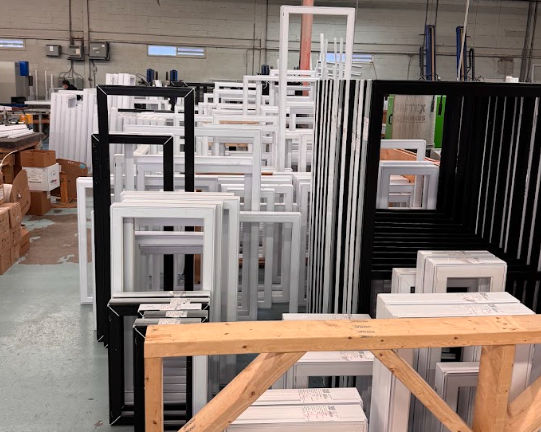

Factory direct means you buy windows from the company that manufactures them, while retail means you buy from a store or dealer that resells windows another company built. The difference shows up in four places: how many businesses add a margin to your price, who measures and installs, who you call when a seal fails, and how closely each window is sized to your actual openings. For a whole-home replacement in Calgary or Edmonton, factory direct usually costs less per opening and keeps one company accountable, while retail makes the most sense for a single stock-size window you plan to install yourself.
This guide compares the two channels side by side, with the dealer model in between, because most Alberta homeowners end up collecting quotes from all three. It walks through how each quote is built, what happens on measurement and installation day, how warranty claims move through each chain, and which consumer rights apply when you sign at your kitchen table instead of a store counter. A separate article covers how a window factory works on the production floor, so this one stays focused on choosing between the ways to buy.
Key Takeaways
- Factory direct means the seller builds the window, while a retail store or dealer resells a product made by another company.
- Every business between the factory and your home adds its own margin, so retail and dealer quotes usually have more pricing layers than a factory-direct quote for a comparable window.
- A shelf price at a big box store rarely reflects the installed cost, because measurement, installation, trim, exterior capping and disposal are often priced separately.
- Retail installation is commonly handled by independent subcontractors, which splits responsibility for the product and the workmanship between different companies.
- Warranty claims are simplest when the company that built the window also installed it, because nobody can argue over whether a failure is a product defect or an installation defect.
- Retail suits small, stock-size, do-it-yourself jobs, while factory direct fits whole-home replacements in older Alberta houses with irregular openings and long, cold winters.
Three Ways to Buy Replacement Windows in Alberta
When you start collecting quotes in Calgary or Edmonton, you will almost always be dealing with one of three business models. All three will show you samples, talk about energy efficiency and quote a price per window, so they can look alike at first. What separates them is who built the product and how many companies stand between the factory and your wall.
Factory Direct: Buying From the Company That Builds the Window
A factory direct company fabricates the windows it sells. It cuts and welds the vinyl frames, assembles the sealed glass units, and ships finished windows from its own plant to your home. The same company usually sends the estimator, schedules production and employs or directly manages the installation crew.
In this model, the quote is built from one company’s costs: materials, fabrication, installation labour and that company’s margin. Weather Pro Windows and Doors works this way, selling its factory-direct windows at contractor pricing without a store or separate brand owner in the chain. The trade-off is range: a factory-direct company sells its own product line, so you choose from the styles and options the factory produces rather than from several brands.
Dealers and Authorized Installers: The Middle Channel
A dealer is an independent business that sells and installs windows produced by one or more outside manufacturers. Many dealers are local, experienced and give good service. The structural point is that the dealer buys finished windows at a wholesale price, adds its own margin and installation costs, and passes the product warranty back to the manufacturer.
That creates two relationships instead of one. The dealer stands behind the installation, while the manufacturer stands behind the window itself. When both are healthy businesses, this can work well, but when one closes, is sold, or drops a product line, the homeowner can end up holding a warranty with nobody local to service it.
Big Box and Retail Stores: Windows Sold as a Product
Home improvement stores sell windows the way they sell faucets or flooring: as products on a shelf or in a special-order catalogue. Stock windows come in standard sizes, and special order windows are built by an outside manufacturer to the dimensions the store submits. If you want the store to install them, it typically assigns the job to an installer in its program, who is usually an independent contractor rather than a store employee.
Retail can suit a homeowner who is comfortable measuring and installing a basement or garage window on their own. For a full house, the model adds layers: the manufacturer, the store, the installation program and the subcontractor who actually shows up at your door. The table below sums up how the three channels compare on the points that matter most after you sign.
| What you are comparing | Factory direct | Dealer | Big box retail |
|---|---|---|---|
| Who builds the window | The company selling it | An outside manufacturer | An outside manufacturer |
| Who measures | Company estimator or measurement technician | Dealer staff | Program installer, sometimes the homeowner |
| Who installs | In-house or directly managed crews | Dealer crews or subcontractors | Typically independent subcontractors |
| Businesses adding a margin | One | Two (manufacturer and dealer) | Three or more (manufacturer, store, installer) |
| Product warranty held by | The seller | The manufacturer | The manufacturer |
| Labour warranty held by | The seller | The dealer | The store or installer, depending on the program |
| Sizing | Built to each measured opening | Ordered from the manufacturer | Stock sizes or special order |
| Product range | One factory’s full line | One or a few brands | Several brands, fewer options each |
How the Price Is Built in Each Channel
Two quotes for what looks like the same casement window can differ by hundreds of dollars per opening, and most of that gap comes from how the price is assembled rather than from the glass. Understanding the layers helps you judge whether a higher number buys a better product or just a longer supply chain. It also explains why a low shelf price at a store can turn into a higher total once the job is installed.
What Sits Inside a Factory Direct Quote
A factory direct quote bundles the window, installation, and finishing work into one price from one company. Materials and fabrication, crew labour, interior trim, exterior capping or sealing and removal of the old unit are either included or shown as separate lines on the same document. Because one company controls every step, it can quote the full job at the estimate without waiting for a supplier’s price list.
Factory direct does not mean the cheapest window on the market. A triple-pane unit with low-e coatings and a warm-edge spacer will cost more than a basic double-pane window, no matter who sells it. Factory direct removes the margin other businesses add for handling the same product on its way to you.
For example, Weather Pro Windows and Doors currently offers new customers 30 to 40 percent off a full project (minimum 3 windows or 2 doors, valid for 30 days), plus a factory rebate of $180 per opening, up to $3,960 total. We offer highly competitive rates and will match any verified competitor’s price for the exact same product under our Price Match Policy.
Where the Extra Layers in a Retail Quote Come From
In a retail or dealer sale, several businesses each need to cover their costs and earn a margin. The manufacturer sells to the store or dealer at a wholesale price, and the store adds its retail margin to cover showroom space, staff, and advertising. If installation is arranged, the program may add a project fee, and the subcontractor who does the work prices their own labour on top.
None of these layers is improper, since each business provides a service. The point for a homeowner is that you pay for every handoff, and the window performs no better after passing through more hands. When you compare quotes, ask each seller directly who made the window and how many companies are involved in installing it.
Why the Shelf Price Is Not the Installed Price
Stock windows at a store are priced to catch the eye, but they are built in standard sizes. Many Alberta homes built between the 1970s and the early 2000s have openings that don’t match current stock dimensions, so a stock window either becomes a special order or needs extra framing, shims, and filler trim to fit. That added work is often where the apparent savings disappear. Items that are commonly priced separately in a retail installation include:
- Measurement or site visit fees charged before an order is placed.
- Removal and disposal of the old windows and frames.
- Interior trim, casing and drywall returns around the new unit.
- Exterior aluminum capping or stucco repair around the frame.
- Surcharges for second-storey openings, bay units or hard-to-reach windows.
A factory-direct company can price all of those items at the in-home estimate, because the same company that builds the window will also do the work.
How to Compare Quotes on Equal Terms
The only fair comparison is a line-by-line one, using the same window styles, sizes and glass package in every quote. The table below lists the lines worth checking and the question to ask about each, regardless of which channel the quote comes from.
| Quote line | Question to ask | Why it matters in Alberta |
|---|---|---|
| Manufacturer | Who built this window? | Tells you who holds the product warranty |
| Energy rating | What are the model number, U-factor and ENERGY STAR status? | Winter lows below minus 30 make heat loss the main running cost |
| Glass package | Double or triple pane, which gas fill, which spacer? | Affects frost and condensation on cold nights |
| Installation | Employees or subcontractors? | Decides who fixes a draft or leak |
| Exterior finish | Is capping or stucco repair included? | Hail and freeze-thaw cycles punish poor exterior sealing |
| Warranty | Who covers glass, frame, hardware and labour? Is it transferable? | Determines who you call in year five |
| Total price | Do removal, trim, disposal, and taxes cost extra? | Keeps a low quote from growing later |
Measurement, Custom Sizing and Lead Time
A quote is only as good as the measurements behind it. This is one of the least discussed differences between factory direct and retail, and it directly affects how well a window seals through an Alberta winter. It also affects how long you wait between signing and installation day.
Who Measures and Who Owns a Measuring Mistake
With a factory-direct company, the person who measures your openings works for the same business that builds and installs the window. If a unit arrives too tight or too loose, that company remakes it at its own cost because nobody else can take the problem.
In a retail purchase, a program installer, a store associate, or the homeowner may take the measurement or fill in dimensions on an order form. If the finished window does not fit, who pays for the remake depends on who wrote down the numbers, and homeowners who measured themselves usually carry that risk.
Stock Sizes vs Custom Openings in Older Alberta Homes
Houses settle, and frames drift out of square over decades. In many pre-2010 homes in Calgary and Edmonton, openings differ in size from one side of the house to the other, even when the windows look identical. A custom window built to each measured opening leaves a small, even gap for insulation and sealant, while a stock window forced into an irregular opening leaves wider gaps that are harder to seal.
This matters more here than in milder regions. When minus 30 outside meets 21 degrees inside, any air path around the frame becomes a cold draft and a spot where frost and condensation form. Sizing is part of the thermal seal, not a cosmetic detail.
Lead Times and Scheduling
Stock windows can be picked up the same day, which is their main advantage for a small job. Special-order windows through a retailer depend on the outside manufacturer’s production queue and the installer’s calendar, and those two schedules aren’t always coordinated.
A factory-direct company controls both schedules, so it can give you a production date and an installation date together. It can also plan around the weather, for example, by opening one wall at a time on a cold day so the house is never exposed to the wind for long. Weather Pro crews typically complete a standard home in a single day.
“When I get called to a home where a store-bought window was installed by a subcontractor, the problem is rarely the glass. It is usually the gap between the frame and the rough opening. In many 1980s Calgary homes, the openings are out of square by a quarter inch or more, so a stock-size unit gets shimmed and filled with foam to make it fit. It looks fine in July. The first Chinook in January is when the homeowner feels the draft.” – Chris Perry, Project Manager at Weather Pro Windows and Doors
Installation: Employees, Subcontractors and Accountability
Installation quality decides how a window performs as much as the product does. A well-built window that is poorly sealed into the wall will still leak air and, in some cases, water. The way each channel staffs the installation determines who is responsible when that happens.
How Retail Installation Programs Usually Work
Most big box installation programs connect the customer with an independent installer who is assigned the job or bids on it. That installer may be skilled and experienced, but they didn’t build the window, and they aren’t the company you paid. They are usually paid per job, which rewards speed.
Before you accept a quote that relies on subcontractors, find out who they are and get it in writing. Canada’s Office of Consumer Affairs recommends asking contractors whether any subcontractors will be involved, and advises that the contract name who is responsible for hiring them, paying them and making sure their work is done right. It also suggests listing the specific products and manufacturers being installed, which is exactly the information that tells you which channel you are really buying through.
How Factory Direct Crews Work
In a factory direct model, installers are either employees or crews working directly for the manufacturer and trained on its frames, fastening methods and sealing details. They install the same product line every week, so they know its tolerances and its weak points.
Accountability is simpler too. If a crew leaves a gap in the sealant, the callback cost falls on the same company that built the window, giving it a direct reason to inspect its own work. That doesn’t make every installation perfect, but it keeps the fix within one business.
What Alberta Weather Does to a Weak Installation
A Chinook can push Calgary’s temperature up by well over 10 degrees in a few hours and drop it again when the wind shifts. Each swing makes vinyl frames expand and contract and works on every bead of sealant around the unit. Edmonton sees longer stretches of deep cold, which puts steady pressure on any air leak, and Calgary sits in one of Canada’s most active hail areas, so exterior capping has to shed water properly after every storm.
An installer who handles several brands may not know each one’s drainage and fastening details. When you interview a window manufacturer in Calgary, ask how its crews finish the exterior on stucco and siding homes and how they insulate the gap around the frame, because those two details decide how the window holds up through the first winter.
Warranty: Who You Call When Something Fails
Most window problems show up years after installation, not in the first month. That is when the structure of the sale matters most, because the salesperson is long gone and you need someone who will take responsibility. The key question is whether the product warranty and the labour warranty sit with the same company.
Product Defects vs Installation Defects
A failed sealed unit, where fog appears between the panes and won’t wipe away, is usually a product defect. A draft around the frame, water staining under the sill or a sash that binds after the first winter is often an installation issue. Sometimes it is hard to tell which, and that is where split warranties cause trouble.
When one company builds and installs the window, the category doesn’t matter because the same business owns both. When the manufacturer and the installer are different companies, each can point to the other, and the homeowner waits while they sort it out.
What Happens When a Dealer or Installer Closes
Window warranties often run for decades, far longer than many small businesses last. If a dealer closes, the manufacturer may still honour the product warranty, but you may have to find and pay a new installer to remove and replace the failed unit. If a subcontractor stops trading, labour coverage through a retail program depends entirely on that program’s terms.
Before signing, ask each seller to show you in writing who handles claims for glass, frame, hardware and labour, and what happens to your coverage if the company is sold or closes. A seller who cannot answer that clearly is telling you something about the chain behind the product.
Transferable Warranties and Resale
A warranty that transfers to the next owner adds value when you sell, but only if the company behind it still exists and the paperwork is clear. A lifetime transferable warranty held directly with the manufacturer, as Weather Pro provides, is easier for a buyer to rely on than coverage split between a brand and an installer they have never heard of. Keep your contract, invoice and product details together with your house documents.
Product Range, Energy Performance and Verifying What You Buy
Retail’s strongest argument is choice, since a large store can show several brands in one aisle. Factory direct offers depth instead, meaning more control over how each window in your home is configured. Whichever channel you use, the energy rating of the exact model matters more than the logo on the brochure.
Range vs Depth
A retailer may carry two or three brands, each with a limited set of stock configurations. A factory-direct company offers one product line but can usually vary the glass package, frame colour, grid pattern, and window style opening by opening. Weather Pro, for example, builds 12 window styles in its own line, from casement and awning units to bay, bow and specialty shapes.
For a whole house, depth is often more useful than range. You want the bedroom egress window, the kitchen awning and the living room picture window to share the same frame system, finish and glass performance, so the house looks consistent and every opening performs the same way in January.
Check the Model, Not the Store
ENERGY STAR certification applies to specific product models, not to a store or a brand in general. Natural Resources Canada advises buyers to ask the vendor for the model information and look it up on the federal searchable product list, which also shows whether an older model is no longer certified. Any seller in any channel should be able to give you that model number before you sign.
This step also helps you compare channels. If a retail quote and a factory direct quote both list certified models, you can compare their published ratings directly instead of relying on sales language. The same guide recommends keeping the labels from your new windows until any rebate claim has been processed, so ask the crew to leave them for you.
Specs Worth Comparing Line by Line
Once you have model numbers, a handful of specifications tell you far more than a brand name. These are the ones to line up across every quote:
- U-factor: overall heat loss through the whole window. Lower is better, and in Canada an ENERGY STAR certified window needs a U-factor of 1.22 W/m²K or lower, or an Energy Rating of 34 or higher.
- Energy Rating (ER): a combined score for solar heat gain, heat loss and air leakage. Higher is better, and it helps compare south-facing windows.
- Glass package: the number of panes, the low-e coatings and the gas fill between them. Triple pane with argon is common for north-facing rooms in Alberta.
- Spacer type: a warm edge spacer keeps the glass edge warmer and reduces frost along the bottom of the pane on cold nights.
- Frame design: the number of internal chambers and how the corners are welded, which affects rigidity and airtightness over decades of temperature swings.
Signing at Home vs Signing at the Store: Your Rights in Alberta
Where you sign the contract changes which consumer protections apply. Factory direct companies usually quote and sign in your home after a free in-home estimate, while retail purchases are often completed at the store. Alberta law treats those two situations differently, and knowing the difference helps you shop without pressure.
The 10 Day Cancellation Right for Contracts Signed at Home
Alberta’s Consumer Bill of Rights explains that when a contractor’s written contract is solicited, agreed upon or signed at your home, the Consumer Protection Act lets you cancel it up to 10 days after you receive your copy. That gives you time to review the numbers, check the model numbers and compare other quotes. The same page confirms your right to be free from high-pressure sales tactics.
A purchase made at a retailer’s own place of business generally does not come with the same statutory cooling-off period, so the store’s own return and cancellation policy governs a special order window. Ask about that policy before you pay, because custom-sized units are often non-returnable once they are ordered. Alberta has also banned unsolicited door-to-door window sales since 2017, so a legitimate in-home estimate is one you booked yourself.
What the Written Contract Should Show
Whichever channel you choose, the contract should name the manufacturer, the exact window models and sizes, the glass package, who performs the installation, what is included in the price, the payment schedule and the warranty terms for both product and labour. If subcontractors will do any of the work, their role should be written in as well.
Financing terms belong in writing too. Weather Pro offers financing from $49 per month, based on about $3,700 financed over 60 months, and 0% APR options for 6 or 9 months through Financeit, on approved credit. Whatever lender is involved, make sure they disclose the total cost of credit before you sign.
When Retail Makes Sense and When Factory Direct Is the Better Fit
Neither channel is right for every job. The project size, your comfort with do-it-yourself work, and the condition of your openings usually decide it. The two lists below describe the situations where each model tends to work well.
Retail Is Often a Good Fit When
- You need one or two windows for a basement, garage or shed, and a standard stock size fits the opening.
- You have installation experience and are comfortable with flashing, insulating and trimming the unit yourself.
- You need a replacement the same day and cannot wait for a custom build.
- The window is in an unheated outbuilding where energy performance matters less than price.
Factory Direct Is Often a Good Fit When
- You are replacing most or all of the windows in the house in one project.
- Your home was built before 2010, and the openings are irregular or out of square.
- You want one company responsible for measuring, building, installing and warranty service.
- You want custom sizes, styles and glass packages that match across every room.
- You are replacing windows and exterior doors together and want one contract, one schedule and one warranty.
The same logic applies in both cities. A homeowner in south Calgary and one comparing the windows Edmonton homeowners are quoted in newer northwest neighbourhoods face the same basic choice: fewer handoffs or more options on the shelf.
Five Questions to Ask Any Seller
These questions work in a showroom, over the phone or at your kitchen table. A seller who answers them clearly, in writing, is easier to hold to account later.
- Did you manufacture this window, and if not, who did?
- Who will measure the openings, and who pays if a unit does not fit?
- Will your own employees install it, or a subcontractor?
- Who handles product and labour warranty claims, and is the warranty transferable?
- What is the exact model number, and is it on the ENERGY STAR product list?
The Bottom Line on Factory Direct vs Retail Windows
The real difference between factory direct and retail is not the window style or the showroom. It is the number of companies standing between the factory and your wall, and each one adds a margin, a handoff and another party to a future warranty claim. Factory direct shortens that chain to one company, while retail spreads it across a manufacturer, a store and an installer.
For a single stock-size window you plan to install yourself, retail is a reasonable and convenient option. For a whole-home replacement in an older Calgary or Edmonton house, where openings are irregular, and the installation has to survive minus 30 nights and Chinook swings, a shorter chain usually means lower cost per opening, custom sizing, and one company answerable for both the product and the work.
Whichever way you lean, make every seller put three things in writing: who built the window, who will install it and who holds the warranty. Once you have those answers, comparing quotes becomes a matter of reading the numbers rather than trusting the pitch.
Factory Direct vs Retail Windows FAQ
Is it cheaper to buy windows factory direct or from a store?
For a comparable window, factory direct is usually less expensive per installed opening because there is no store or dealer margin on top of the manufacturer’s price. A stock window at a store can have a lower shelf price, but once you add measurement, installation, trim, capping, and disposal, the installed total is often similar or higher. Compare quotes line by line using the same sizes and glass package.
What is the difference between a window manufacturer and a window dealer?
A manufacturer builds the window, and a dealer resells windows built by an outside manufacturer, often with its own installation service. With a dealer, the product warranty usually stays with the manufacturer while the dealer covers the labour. With a factory-direct manufacturer, one company covers both.
Do big box stores make the windows they sell?
Generally, no. Large home improvement retailers stock windows from outside manufacturers and send special orders to those manufacturers for production. The manufacturer provides the product specifications and warranty, not the store.
Who installs windows bought from a big box store?
The store usually arranges installation through its installation program and has independent contractors do the work rather than store employees. Ask the store who the installer will be, whether they are insured and who handles labour warranty claims before you pay.
Can I cancel a window contract I signed at home in Alberta?
Under Alberta’s Consumer Protection Act, you can cancel a contractor contract solicited, agreed upon, or signed at your home up to 10 days after you receive your copy. A purchase made at a store is generally governed by the store’s return and cancellation policy.
Are factory direct windows lower quality because they cost less?
No. The lower price comes from removing reseller margins, not from using cheaper materials. Quality depends on the frame design, glass package, spacer and installation, so check the model’s U-factor and ENERGY STAR listing and compare those specifications rather than the price alone.