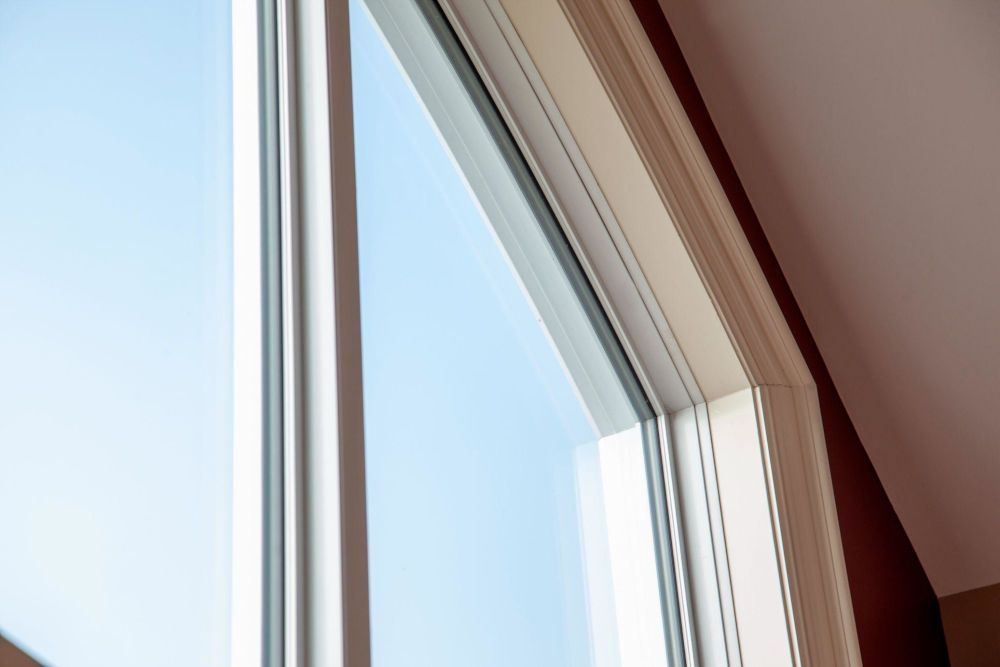

Window casing is the moulding on the room side of the opening, and brickmould is the exterior trim that covers the joint between the frame and the cladding. Casing hides the gap where the frame meets drywall. Brickmould finishes the joint you see from the yard. Neither board is the frame, and neither board is the layer that keeps rain out of the wall.
An installed replacement includes interior and exterior finishing in the price. New interior trim on a full-frame replacement is a separate line when that trim has to be built new. A retrofit that leaves a sound casing in place is a smaller scope than a full-frame job that takes the casing off so the rough opening can be seen. The glass package does not tell you which of those jobs the number is for.
The boards are the last layer. Behind the brickmould, flashing and a drainage path move water out and away from the wall. Behind the casing, the gap between the frame and the rough opening is insulated and sealed. A price that names only the moulding and is silent on that gap is a price for a different job.
Key Takeaways
- Window casing is the interior moulding around the frame, and brickmould is the exterior board over the joint with the cladding.
- Casing is one kind of trim. The frame, the sash, and the glass are not casing.
- On an installed Weather Pro price, interior and exterior finishing are included, and new interior trim on a full-frame replacement is quoted separately.
- A retrofit can leave sound interior casing in place. A full-frame job takes that casing off so the opening behind it can be checked.
- Brickmould and a bead of exterior caulk do not replace flashing. The bead is the last defence against rain, and a weak one.
- Two quotes are comparable when both name the same trim scope. Matching the glass and skipping the trim leaves the totals meaningless.
- On an older house, softness at the bottom corner of the exterior board changes the method before it changes the pane count.
What is window casing?
Window casing is the moulding that runs around the window on the room side and covers the gap between the frame and the finished wall. It is fastened to the jamb and to the edge of the drywall, and it is the board you paint when you paint the room. The frame stays in the wall, and the casing is only the finish in front of it.
What is the difference between casing and the window frame?
The window frame is the box fixed in the opening: a head across the top, a jamb on each side, and a sill at the bottom. Casing sits on the room face of that box. If you can ease the board away from the drywall and the glass does not move, you are on the casing. If the jamb feels soft when you press it, or the sill is dark and crumbly under the paint, you are on the frame, and the casing was only hiding the damage.
The gap casing covers is the space the shims and the seal leave between the frame and the rough opening. Casing hides that gap and lines the opening up with the door casing in the same room. It does not carry the glass, and it does not square a wall that has moved. A new board follows the wave. It does not pull the wall back.
The parts of a window are the frame, the sash, and the glass, and you have to name the failed part before anyone prices a replacement. Casing is trim around that assembly. A fresh board will not clear fog between the panes, and it will not free a sash that has seized. Spend the first minute of any visit on which of those you are actually buying.
Jamb depth is the other mix-up. Some walls are thicker than the frame is deep, so a plain or extended jamb fills the wall thickness, and the casing then trims the room face of that extension. The extension helps the frame meet the drywall. It is still not casing. If a quote says “jamb extension” and “casing” as one item, ask which piece is which, because one is buried in the wall thickness and the other is the board you will look at every day.
What is the difference between casing and trim?
People look up window casing vs trim because the two words get swapped on paper. Trim is the wider word. It covers casing, the stool (the flat interior ledge), the apron under that ledge, and sometimes the exterior boards as well. Casing is the specific moulding around the window. Interior window casing is that room-side moulding. It is not the exterior sill, and it is not the brickmould.
A line that says “trim included” has not said whether the stool stays, whether the apron is replaced, or whether only the side boards are caulked and left. Those three pieces often come off together on older openings because they were nailed as one set. If the quote keeps the stool and replaces the sides, the ledge will sit proud of the new boards, or short of them. Name the stool, the apron, and the casing as three items, even when the answer on two of them is that the existing pieces stay.
The stool is the piece people call a sill from inside the room. The exterior sill is the sloped part of the frame that sheds water. They share a job only in conversation. On the quote, they are different parts, on different sides of the wall, and only one of them is interior trim. If water stains the stool, look at the exterior sill and the joint under the brickmould before you blame the interior board.
What is window brickmould?
Window brickmould is the exterior trim around the frame. It covers the joint where the frame meets brick, stucco, or siding, and it gives the opening a finished edge from the yard. It is not interior casing turned around: the board is shaped so water runs off its face, and the name comes from the old joint against brick, even when the wall is now siding.
What does brickmould not do?
The head of the board has an order, and getting that order wrong is the failure people blame on the profile. A drip cap, or head flashing, sits above the frame and kicks water out over the brickmould. The top of the board tucks under that cap. If you can see the top edge of the brickmould above the metal, water that hits the head can get behind the board no matter how neat the mitres look.
Brickmould doesn’t flash the head of the window, and it doesn’t drain the sill. Natural Resources Canada calls exterior caulking the last and weakest defence against rain entering a wall from the outside, and it puts properly applied flashing and a drainage plane ahead of that bead. The moulding can cover a sound detail. It cannot invent one. If the head has no drip, a handsome board still leaves the sheathing to take the water.
Caulk on the outside also waits until the interior seal is done. Seal the room side first. If the exterior bead goes on before that, warm moist air can be trapped in the wall, and the damage shows up later as soft wood, not as a draft you notice in January. A quote that lists caulk and brickmould, and never mentions flashing, is describing the cover, not the water path.
When is a window detailed with no brickmould?
Brickmould vs. no brickmould is a real choice, and it is not a style preference first. A flush detail, where the cladding or a metal cap runs tight to the frame, can close the joint without a projecting board. That detail still needs the flashing and the seal behind it. What it skips is the shadow line of a traditional brickmould. On a brick veneer, no brickmould often means the brick was laid tight to a nailing flange, or a thin metal mould was used instead of a wood board. On siding, it often means a channel or a cap is the finish.
The quote should say which detail you are getting. No brickmould, with no other exterior finish named, leaves the joint to whoever touches the cladding, or to you after the crew leaves. On a replacement, the wall already has one detail or the other. Matching it keeps the siding courses and the brick line where they are. Changing it means cutting cladding back. That cut is its own line if the included exterior finishing does not already cover it. Ask before you treat a cleaner look as free.
A supply-only window sold with brickmould attached is a different sentence again. The board may be on the unit in the box. That sticker does not include removing your old window, sealing the rough opening, or the labour to tie the new board into your cladding. An installed quote’s exterior finishing line is the board plus that joint. Compare those two only after you have put labour, disposal, and the cladding tie-in back onto the supply-only price.
Which casing styles belong on a replacement?
Window casing styles are the profiles already in the room: a flat board, a colonial shape with a curve at the edge, or a craftsman board with a simple step. Keep the old profile when the casing stays, and match the baseboard and the door casing in that room when it comes off. Vinyl window casing is the usual exterior phrase when old wood has failed, while interior window casing is usually a paint-grade board that takes the same paint as the doors.
What does exterior window trim have to survive?
Exterior window trim lives in weather the interior casing never sees. It takes sun on the face, water at the lower corners, and movement every time the wall temperature changes. A hairline split at a mitre is where that water starts. Paint on wood slows the damage. It does not stop it once the end grain at the mitre is open, because end grain drinks more water than the face does.
Exterior window casing is the same job as brickmould when a quote uses that phrase for the outside. Read it as the outside board. If the line also says capping, that is usually metal folded over the old wood, not a new brickmould. Capping and brickmould are different repairs. One wraps what is there. The other replaces the board. A price that uses both words in one figure doesn’t say which repair you are buying. Wrapping soft wood traps moisture. Replacing the board, and dealing with what is behind it, is the repair that lasts.
The new board’s projection has to meet the cladding. A thicker brickmould kicks siding out or leaves a ledge that holds water against the frame. A thinner one leaves a step the old shadow line didn’t have, and the siding courses no longer sit cleanly against it. Matching that projection is a measurement, the same kind of measurement as the opening’s width and height. “Standard brickmould” is not a size until someone has held the old board up to it.
Do not let the word vinyl cover both sides of the wall. The unit is chosen from the vinyl replacement windows built to the measured opening, and the casing is specified after that size is known. The trim has to fit the frame that was ordered. A stock board from a bin is a different product from a board cut to the reveal you still have.
What should the window replacement quote say about the trim?
A window replacement quote is comparable only when the trim lines match. Two numbers for the same living room can differ widely because one price keeps the casing and the other builds it new, or because one price includes a brickmould and the other stops at the frame. The glass can be identical on both sheets, while the trim scope differs.
What does the installed price already include?
An installed window price is the window, the labour, the sealing, and the finishing, not the unit on its own. For standard operating vinyl windows, the budgeting range runs from $520 to $1,560 installed with double-pane glass, and from $620 to $1,800 with triple-pane glass. Picture and fixed units start at $480. Those figures are examples for budgeting; the exact price follows a free in-home measurement, and the list prices are the same across the provinces served. What moves the number is the specification, above all double pane or triple pane, and the size. Weather Pro’s estimator names retrofit or full frame for each opening before that number is written, and can price both where either would work. Bay, bow, and specialty shapes are quoted from the configuration, and the trim around them is written the same way, not assumed from the style name.
Every one of those installed prices includes the unit built to the measured opening, removal of the existing window, insulation and sealing, interior and exterior finishing, cleanup and haul-away, and warranty registration. Finishing, in that list, is the work that closes the opening after the unit is in. It is not a blank cheque for a new interior trim package on every full-frame opening. That distinction is why the next items exist as their own lines. White is the standard frame finish. A colour or laminate on the frame is an upcharge with no published dollar amount, and it is not the same thing as painting the interior casing.
What is quoted separately when the opening needs it?
We quote four items separately when they apply: repair of rot or damage found behind the existing frame, a structural change to the opening, new interior trim on a full-frame replacement, and access equipment on an upper floor. They are separate because not every house has them. A sound main-floor retrofit does not need them. A rotten sill on a second-floor full-frame opening may need all four.
| Quote line | How it is priced |
|---|---|
| Interior and exterior finishing | Included in the installed price |
| Cleanup, haul-away, and warranty registration | Included in the installed price |
| New interior trim on a full-frame replacement | Quoted separately when it applies |
| Repair of rot or damage behind the frame | Quoted separately when it applies |
| Structural change to the opening | Quoted separately when it applies |
| Access equipment on an upper floor | Quoted separately when it applies |
Read the grid against your own openings, not against a neighbour’s total. Add every separate line that your house actually needs before you decide one quote is lower. A sheet that looks cheap and is silent on rot, on new interior trim, and on how the crew will reach a bedroom over the garage is not a lower price. It is an unfinished one. The published range already assumes an installed scope. It does not assume a new casing set, a rebuilt sill, or a lift. If you want those, they should appear as dollars on the page, not as a remark that the crew will see on the day.
When does the casing stay, and when does it come off?
The casing stays when the frame it is nailed to is worth keeping. A retrofit leaves the existing wall frame in place. The old sashes and glass come out, the new unit goes into that frame, and the interior trim is left untouched when the frame is square, dry, and sound. That path costs less and takes less time, and it is the right path only when the frame passes that test. A casing that looks fine can still be sitting on a jamb that is soft an inch in from the paint. The check is the frame, not the colour of the board.
The casing comes off when you remove the frame. A full-frame replacement removes the assembly back to the rough opening. This requires more labour, more insulation, and new trim, which is why it costs more; it is the path when the frame has rot, the opening has shifted, or the window size has to change. With the casing off, the crew can see the sill and the cavity a retrofit never reaches. New interior trim on that path is a separate line. Exterior finishing stays inside the installed scope. Do not collapse those two into one promise.
Weather Pro manufactures factory-direct vinyl windows and installs them with its own crews, so the person who measured the casing is tied to the crew that has to make the unit fit. The reveal check happens at the measurement, not after the unit is built to a size the old boards cannot cover. If the old casing will not reach the drywall once the new frame is in, the quote should already say the casing is coming off.
“I press the exterior board and the interior casing before I talk about glass. If the brickmould gives under a thumb, or the casing has to come off because the frame behind it is soft, that opening is a full-frame scope. The pane count comes after that,” says Chris Perry, Project Manager, Weather Pro.
There is a limit to keeping the casing. Staying means the boards still cover the joint once the new unit is in, and they are still fastened to dry wood. A casing that has pulled off the drywall, or a stool that rocks because the sill under it has shrunk, is not a casing you keep to save a line. Keeping it means living with the gap, or caulking a gap the board was meant to cover. That interior bead is a patch. It is not the same as trim that was fitted to the frame.
Take one bedroom as a worked case. The frame is square, the jamb is dry, and the casing still covers the drywall. The bottom corner of the brickmould gives under a thumb, and the head flashing is intact. That opening can stay a retrofit: interior casing remains, exterior finishing replaces the soft board and redoes the joint, and there is no new-interior-trim line and no rot line. Change one fact. The sill is soft under the stool. The same bedroom becomes a full-frame opening. The casing comes off, the rotten wood is a separate repair, and new interior trim is a separate line. The glass you wanted did not change. The sheet did.
How does a same-day temperature swing treat exterior trim?
Exterior trim moves when the wall temperature moves. A mitre that was tight in the morning opens when the board expands, and a bead of caulk that was gunned in cold weather has to stretch when the afternoon is warm. The harsher version of that test is a wind that descends the lee side of the mountains and warms as it falls. Parks Canada records that, in only a matter of hours, chinooks can raise temperatures rapidly, and that winter temperatures can swing from well below freezing to above 10 C. That record is from Waterton Lakes, where these winds are frequent. A joint on the prairie side of the Rockies has to survive the same kind of day.
On a day that climbs through freezing and falls back, the exterior bead is asked to flex twice, which is why window installation in Calgary has to leave a joint that can move before the season is over. The crack that opens is thin. Wind-driven rain does not need a wide one.
Farther north, a cold spell that holds for weeks keeps the same joint contracted until meltwater runs, which is why replacing windows through an Edmonton winter is judged in the thaw as much as on the afternoon the board was nailed. A bead that looked complete in January can be the path that water uses in April if it never bonded to the board.
The material follows that test. Wood brickmould painted on the face still has end grain at every mitre. A vinyl or capped board does not drink at the cut end the way wood does, and it does not need a fresh coat of paint to stay closed. It still needs a joint that can move, and it still needs flashing behind it. Changing the material and leaving a failed head detail only changes what the water stains. The quote should name the exterior material for that reason, not because one product is a slogan.
Caulk still needs a clean surface and enough depth to stretch into. A thin smear over old paint looks finished from the sidewalk and lets go at the first real movement. That workmanship sits inside the finishing line.
Where does original casing fail before the glass does?
The 2021 Census counted 1,626,835 occupied dwellings that are not condominiums and were built from 1961 to 1970. On a house from those years, the finish around the window is often still the original wood, inside and out. The glass may be a later sealed unit set in an older frame. The boards at the perimeter are the pieces that stayed, because they still looked like trim.
The failure starts at the bottom corner outside. Press it. Sound wood pushes back. Soft wood gives, and the paint may still be intact over the softness, because paint bridges a gap until it cannot. Inside, look for a casing that has separated from the drywall at the mitre, or a stool that is stained at the horns, the short returns at each end of the ledge. Those stains mean water crossed the sill. They do not mean the room is simply humid. A new interior board over a wet sill repeats the stain.
Replacing the visible board and leaving the wet wood behind it is the repair that comes back. If rot is found behind the frame, that repair is quoted separately from finishing. It is not folded into the casing price, and it should not be. You want the number where you can see it. A new casing does not dry a wall. It only hides the opening while the wall stays wet. Tape, filler, and a coat of paint can make the corner look resolved for a season. They do not restore wood that has already lost its strength.
An interior bead where the casing meets the wall cuts air leakage at the trim, and it does nothing for an empty cavity behind that trim. If the boards come off easily and the gap is bare, the useful work is insulation and a seal, then the trim goes back.
Fog between the panes is the contrast that keeps the diagnosis honest. That moisture is inside the sealed unit. No casing profile or brickmould reaches it. If the outdoor pane of a double unit is cracked and the indoor pane is intact, you still have a sealed assembly that has lost a layer, not an empty hole in the wall, and the trim around it may be perfectly sound. Price the glass failure and the trim failure as the things they are. A quote that replaces both because one looks tired is spending your money on the board that didn’t fail.
How do you compare two trim scopes before you compare two totals?
The total is the last number you read. The trim scope is the one that makes two honest quotes disagree. The usual mismatch is the method: one sheet is a retrofit that leaves the casing, and the other is a full-frame replacement with new interior trim. The next mismatch is the exterior: brickmould on one sheet, metal capping on the other, or a flush detail that assumes someone else will cut the siding. Either mismatch can be larger than the difference between two casing profiles.
A window replacement quote that itemizes glass, size, and style, and then says finishing is included in one line, still needs the trim answers written out. Finishing is real scope. It is not a synonym for every board that could be added later. Put the answers next to each opening. A kitchen window over a sink and a bedroom window over a garage are not the same access, and they may not be the same frame condition. One rotten corner does not set the method for the whole house.
Check these lines before you look at the bottom of the page.
- Retrofit or full frame. The line names the method for that opening, because the boards follow the method.
- Interior casing. It stays, or new interior trim is a separate dollar line.
- Exterior joint. Brickmould, metal capping, or a flush detail, named as one of those.
- Material on each side. Specify the interior and exterior boards separately.
- Work behind the frame. Mark rot, structural changes, and upper-floor access as in or out.
- Caulk and paint. If you expect a painted casing or a finished bead, the sheet says so.
Add the price of any missing line to the quote that left it out. Then compare the totals. A longer warranty does not repair a sheet that never named the brickmould. Settle the boards first. If one contractor will not write the answer, you do not yet have two quotes. You have one quote and a guess.
Paint is the item people assume. Interior finishing can mean the boards are installed and left ready for the painter you already hired, or it can mean the crew paints them to match the room. Exterior finishing can mean a prefinished board, or a board that still needs a coat. Neither reading is obvious from the word finishing. The sheet should say which one you are getting, in a short clause, so the lowest total is not simply the total that left the painting to you.
Match the casing and the brickmould before you match the price
Window casing and brickmould are the two boards a quote has to name before the total means anything. Casing covers the drywall gap on the room side. Brickmould covers the joint with the cladding. Flashing and the seal sit behind both.
An installed price includes interior and exterior finishing, along with the unit, removal, insulation, sealing, cleanup, and warranty registration. New interior trim on a full-frame replacement, rot behind the frame, a change to the opening, and access equipment are separate, when applicable. A retrofit that keeps sound casing is a different job from a full-frame opening that has to be trimmed again.
If the exterior bead is being asked to keep the rain out, the detail is not finished. The bead is the last layer, and a weak one. Head flashing and the drainage path do the work the board only covers. A new profile on a backwards head detail will look better for a season and wet the same sheathing.
Weather Pro builds each unit to the measured opening and installs it with its own crews, so the casing and the brickmould belong on the same written estimate as the window. A free in-home quote includes measurements that show whether the casing stays and what the exterior joint needs.
Frequently Asked Questions
What is a window casing?
Window casing is the moulding around the window on the room side. It covers the gap between the frame and the finished wall, and it is the board you paint with the room. It does not hold the glass, and it is not the frame.
What is the difference between window casing and the window frame?
The frame includes the head, jambs, and sill, fixed in the opening. Casing is the finish on the room-facing side of that frame. If the board can come off and the glass stays put, you were looking at casing. If the jamb is soft, the problem is the frame under the casing.
What is the difference between trim and casing?
Trim is the general word for finish moulding: casing, the stool, the apron, and other boards in the room. Casing is only the moulding that surrounds the window or the door. A quote that says trim but doesn’t name the stool and the apron hasn’t specified the interior set.
What is brickmould on a window?
Brickmould is the exterior trim around the frame. It covers the joint between the frame and the cladding, whether that cladding is brick, stucco, or siding. It is not interior casing, and it is not a substitute for flashing at the head.
Why is it called brickmould?
The name comes from masonry joints, where the board closed the gap between the frame and a brick veneer. The same profile is now used on walls with no brick. The word on a quote means the exterior trim profile, not a promise that your wall is brick.
Can you replace a window without replacing the casing?
Yes, when the job is a retrofit, and the casing and the frame under it are square, dry, and sound. The new unit has to sit so the existing casing still covers the joint. If the frame is rotten, or the casing no longer reaches the drywall once the new unit is in, the casing comes off, and new interior trim is a separate line item.
Does a full-frame quote include new interior trim?
We quote new interior trim on a full-frame replacement separately when it applies. Interior and exterior finishing stay in the installed price. A new set of casing, stool, and apron is an added line item, and exterior finishing is not that line.
Is exterior caulk the same thing as brickmould?
No. Brickmould is the board, and exterior caulk is the bead at its edges. The bead is a weak last line of defence against rain, while flashing and a drainage path keep water out of the wall. A quote can include both the board and the bead, but it still has to name the flashing.