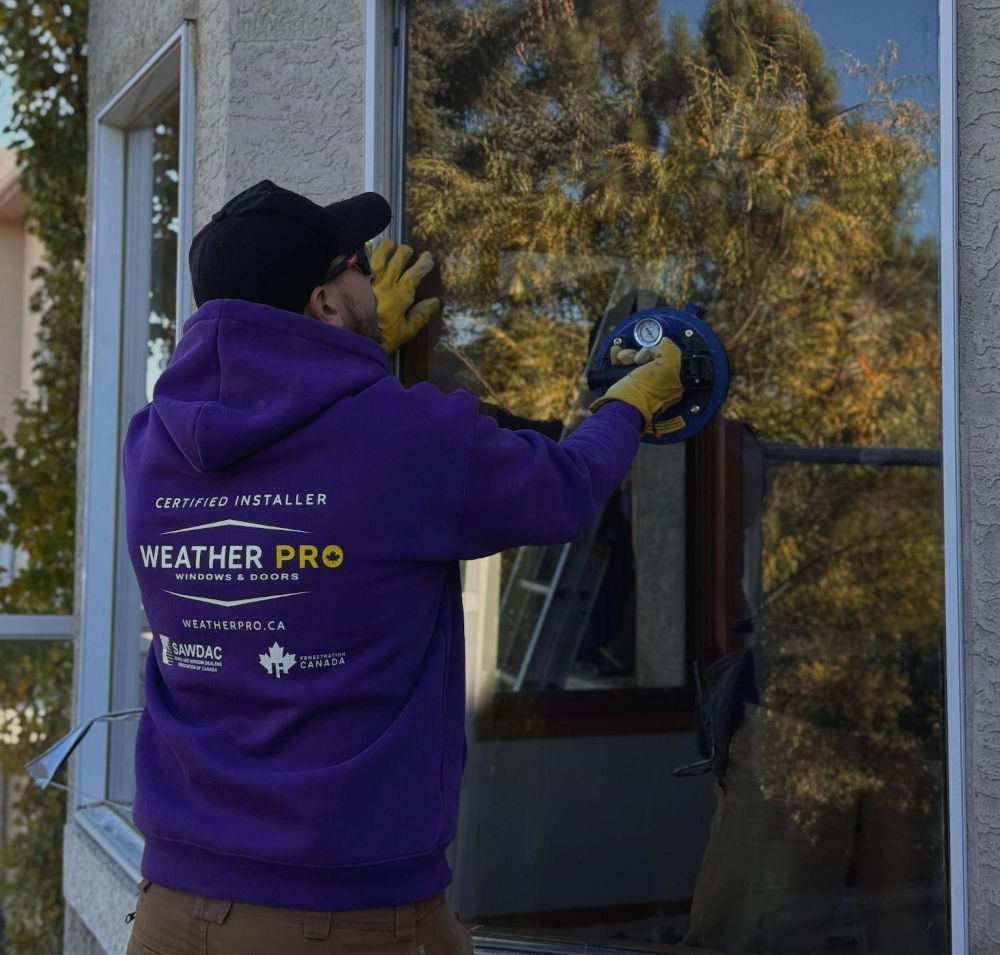

Choose the company based on four things: who actually makes and stands behind the product, who physically installs it, what the written quote itemizes, and what the warranty covers for labour and the window. Those four answers separate a company that will still be reachable in year eight from one that quoted a low number and left the finishing, the insulation, and the service call for you to sort out later. Price belongs in the decision, but it is the last filter, not the first, because in Alberta, installation determines whether a well-made window performs as its label claims.
This guide covers how to tell a manufacturer from a dealer from a sales agency, how to read performance numbers instead of adjectives, the questions that separate serious companies from the rest, the red flags worth walking away from, what belongs in a written quote and contract under Alberta consumer law, and how to compare two quotes that look nothing alike.
Key Takeaways
- The company you hire affects long-term performance more than the brand name on the window, because installation quality decides whether a well-made unit performs as rated.
- Ask whether the company manufactures its own product, resells another manufacturer’s product, or only sells and subcontracts the installation. That single answer changes accountability, lead times, and service response.
- Performance claims should be checked against measured values such as U-factor and Energy Rating. R-value is commonly quoted in sales conversations but is not part of the Canadian standard for windows.
- Alberta conditions punish weak sealing and poor anchoring faster than milder Canadian climates do, with Chinook cycling in Calgary and sustained deep cold in Edmonton working on every joint.
- A quote that does not itemize the glass package, installation method, finish, insulation, disposal, and warranty cannot be fairly compared to any other quote.
- Alberta law allows you to cancel a contract signed in your home within 10 days, so no legitimate company needs a decision from you on the spot.
Why the Company Matters More Than the Window Brand
Two homes on the same street can receive the same window from the same production line in the same week and still get very different results five winters later. The difference is almost never the unit. It is how the opening was prepared, how the frame was anchored and insulated, and who answers the phone when something moves.
Installation decides whether the rated performance is real
A window is tested and rated as a sealed assembly in a laboratory. The moment it goes into a rough opening, its real-world performance depends on things no label can certify: whether the frame was shimmed square at the lock point, whether the cavity around it was insulated without over-compressing the frame, whether the flashing directs water away from the wall, and whether the interior air seal is continuous. Get those wrong, and a triple-pane unit with an excellent Energy Rating will still feel drafty and collect frost at the glass edge.
This is why the most useful questions you can ask are about method, not product. Any salesperson can recite a spec sheet. Fewer can describe how their crews handle a settled opening on a 1978 bungalow without cutting into the vapour barrier.
Alberta is harder on installations than most of Canada
Calgary experiences repeated Chinook swings that can change the temperature by 15°C or more within hours, causing frames, fasteners, and sealants to expand and contract far more often than in a stable climate. Edmonton sees the opposite problem: weeks of sustained cold in the -20°C to -30°C range with no relief, which pushes heat out through every weak point continuously rather than in short bursts. Add hail exposure across southern Alberta and strong sun on south and west elevations, and you have a province where a merely acceptable installation degrades noticeably faster than it would in Vancouver or Halifax.
A company that works here full time will talk about these conditions without being prompted. If a sales conversation could have been held anywhere in the country, that signals how much local field experience is behind it.
Manufacturer, Dealer, or Sales Agency: Who Are You Actually Hiring
The window industry uses similar language across very different business models, and homeowners rarely find out which one they hired until something needs fixing. There are three common structures, and each one changes who is accountable when a sealed unit fails in year six.
The three models, and what each one means for you
| Business model | Who makes the product | Who installs | What it means when something fails |
|---|---|---|---|
| Manufacturer that installs | The company, in its own plant | Its own employed crews | One party is responsible for product and labour, and replacement parts come from the original line |
| Dealer or reseller | A third-party manufacturer | Employed or subcontracted crews | Product claims go to the manufacturer, labour claims go to the dealer, and you sit between them |
| Sales agency | A third-party manufacturer | Fully subcontracted crews | The company that sold you the job may have no crews at all, and service depends on who is still under contract |
None of these models is automatically wrong. A good dealer with long-standing supplier relationships can serve you well. The problem is not the structure; it is not knowing which structure you bought into.
The question that reveals it in one answer
Ask directly: “Do you manufacture these windows, and are the installers your employees or subcontractors?” A company with nothing to hide answers in a sentence. Vague answers about partners, exclusive lines, or certified affiliates usually mean there are more parties in the chain than the sales conversation suggested.
There is a second, quieter test. Ask whether they can supply and service both windows and exterior and entry doors from the same production and service chain. Companies that broker products from several sources often have very different answers for the two categories, which tells you how the business is actually put together.
How to Verify Performance Claims Before You Sign
Performance is the easiest part of a window quote to check, because Canada rates fenestration with published, measurable values. Sales language varies. The numbers do not. If a company cannot produce the numbers for the exact configuration being quoted, that is your answer.
Read the values, not the adjectives
According to Natural Resources Canada, energy performance of windows and doors sold in Canada is tested to the CSA A440.2 standard and reported using values such as U-factor (lower is better) and Energy Rating (higher is better). The same source notes that R-value is not part of the energy performance standards for these products even though contractors and sales staff often quote it. That single detail is a practical filter: a quote built around an impressive R-value, with no U-factor or ER for the actual unit, is being sold on a number that the standard does not use for windows.
Ask for the U-factor and ER of the specific configuration, meaning the frame, the number of panes, the coating, the gas fill, and the spacer as quoted. A number pulled from the company’s best-performing product is not the number for the window going into your wall.
ENERGY STAR certification tells you something, but not everything
ENERGY STAR certification confirms that a unit was tested by an accredited laboratory and verified independently. It does not confirm that the crew arriving at your house will install it properly, nor does it certify a combined assembly. When several units are mulled together into one large opening, certification applies to the individual units rather than to the combined group, which matters if you are quoting a large living room wall that combines a fixed picture unit with double slider windows.
Treat certification as a floor, not a finish line. The useful follow-up question is what the company does at the opening to protect that rated performance once the unit leaves the plant.
The Questions to Ask Every Window Company in Calgary and Edmonton
Bring the same list to every in-home appointment and write down the answers. The value is not in any single response; it is in comparing how three companies answer the same twelve questions. Patterns appear quickly.
- Do you manufacture the product or resell it? Establishes who owns the warranty on the unit itself.
- Are your installers employees or subcontractors? Determines who is accountable for workmanship and who returns for service.
- Is this quote for a retrofit or a full-frame installation? The single largest scope difference between two quotes that look similar.
- What are the U-factor and Energy Rating for the exact unit quoted? Turns a performance claim into a checkable figure.
- What spacer system is used in the sealed unit? Older aluminum spacers conduct cold to the glass edge, which is where Alberta frost starts.
- How do you insulate and air seal around the frame? Ask specifically about low-expansion foam and whether the interior air seal is continuous.
- Who is responsible for interior and exterior finishing? Trim and capping are the most common items quietly excluded from a low quote.
- Who removes and disposes of the old units? Confirm in writing rather than assuming.
- What does the warranty cover on labour, and for how long? Product and labour warranties are separate documents with separate terms.
- How long has the company been operating in Alberta, and can you provide local addresses for recent installations? National review counts matter less than work you can drive past.
- What is the deposit, and what is the payment schedule tied to? Payments should track project milestones, not the calendar.
- What happens if a unit arrives damaged or measured wrong? Every company has this happen. The answer tells you how they generally handle problems.
“When we get called out to look at someone else’s installation, the window itself is almost never the problem. It is usually low-expansion foam packed too tightly around the frame, or missing shims at the lock point. In Calgary, that shows up within a season or two because a Chinook can move the frame temperature by twenty degrees in an afternoon, and the sash stops meeting the compression seal evenly across its length. Ask a company how they shim and insulate the opening. The answer tells you far more than any brochure.” Chris Perry, Project Manager at Weather Pro Windows and Doors
If a company answers ten of the twelve clearly and gets stuck on warranty terms or crew structure, that is worth pressing on rather than dismissing. If a company treats the list itself as an obstacle, you have learned what you needed to know.
Red Flags That Should End the Conversation
Most window companies operating in Alberta are legitimate businesses doing competent work. The problems tend to be concentrated in a few recognizable behaviours, and all of them are visible before you sign anything.
Pricing that expires today
A discount that disappears when the salesperson leaves your kitchen is a negotiating tactic, not a price. Manufacturing costs do not change between Tuesday evening and Thursday morning. Any legitimate seasonal promotion has a stated end date, applies to everyone, and survives you taking two days to think.
Deposits that do not match the work
A modest deposit upon order confirmation is normal because custom units are produced specifically for your openings. A demand for half or more of the project value before anything is measured or manufactured is not. Payments should be tied to defined milestones, such as order confirmation, delivery, and completion, and the schedule should be set out in writing in the contract.
Verbal promises that never reach the paperwork
Anything promised out loud and absent from the contract does not exist. This applies to capping colour, interior finishing, disposal, screen inclusion, service response times, and warranty transferability. The fix is simple and non-confrontational: ask for it to be added to the written quote before you sign.
Warranty language that avoids specifics
“Lifetime warranty” on its own is marketing until you see what the term means in the document. Whose lifetime, the product’s or the owner’s? What is covered: the sealed unit, the frame, the hardware, the labour to install a replacement part? Is it transferable to the next owner, and does transfer require a fee or a form? A company that answers those four questions precisely is telling you something reliable about how it operates.
Reluctance to provide local references
Ask for addresses of completed projects in your city, not just a portfolio gallery. Companies with real local volume can produce them without hesitation. If you are comparing options for windows Edmonton homeowners have installed recently, driving past two or three finished jobs tells you more about exterior capping and finishing quality than any photograph.
What a Written Quote and Contract Should Include in Alberta

Alberta consumer law gives homeowners meaningful protection on contracts signed at home, and knowing those protections changes how a high-pressure appointment feels. It also sets expectations for what a written agreement must contain.
Your rights under Alberta consumer protection rules
The province’s Consumer Bill of Rights sets out that when a contract is solicited, agreed to, or signed at your home rather than at the contractor’s normal place of business, you may cancel it within 10 days of receiving your copy, without giving a reason. It also confirms your right to be free from high-pressure sales tactics, and your right not to be charged more than 10 percent above an estimate, to a maximum of 100 dollars. Those three provisions together remove nearly all of the urgency a pressured sales appointment tries to create.
Keep your signed copy and note the date you received it, because the cancellation window runs from that point. Cancellation should be sent in a way you can prove, such as registered mail or email to the address stated in the contract.
The line items that should appear in writing
Use this as a checklist when you review each quote side by side. Anything missing is a question, not necessarily a problem.
| Contract element | What to confirm before signing |
|---|---|
| Product specification | Style, frame material, pane count, Low-E coating, gas fill, spacer system, colour, screens |
| Installation method | Retrofit or full frame, stated per opening rather than for the project as a whole |
| Sealing and insulation | How the cavity is insulated, how the interior air seal is made, how flashing is handled |
| Finishing | Interior trim and exterior capping, materials and colour, and who supplies them |
| Removal and disposal | Whether old units leave the site and who pays for it |
| Schedule | Order confirmation, expected production time, install date, and completion |
| Payments | Deposit amount and what each subsequent payment is tied to |
| Warranty | Separate terms for product and labour, duration, transferability, service process |
Two quotes that both look complete can still differ by thousands of dollars once you map them against this list, and the gap is usually finishing, insulation detail, and labour warranty rather than the window itself.
Warranties: What Lifetime Actually Means
Warranty is where the difference between companies becomes concrete, because it is a promise that only matters years after the sale. Read both documents, the product warranty and the workmanship warranty, before you compare final prices.
Product warranty versus workmanship warranty
The product warranty covers the unit: the frame, the sealed glass unit, and usually the hardware, each often with its own term. The workmanship warranty covers the installation: the seal around the frame, the finishing, the flashing, and anything that moves or leaks because of how the window was fitted rather than how it was built. A strong product warranty attached to a one-year labour warranty leaves the more likely failure uncovered, because installation faults show up in the first several Alberta winters while sealed units typically fail later.
Transferability and what it is worth
A transferable warranty carries to the next owner of the home, which matters if you may sell within the warranty term. It is also a small but real selling feature at resale, since a buyer’s inspection that turns up recent windows with remaining coverage removes a negotiating point. Ask whether transfer is automatic, whether it requires notification, and whether any fee applies.
The service question nobody asks
Ask what happens mechanically when you call for warranty service. Who takes the call, how long until an assessment, who supplies the part, and who pays for labour on a covered repair. A company with a clear answer has done so many times. If you want to compare current window prices across companies fairly, the service answer belongs in that comparison, because a cheaper job that needs a paid service call in year four was not cheaper.
Comparing Quotes Without Getting Burned
Three quotes are worth collecting, and the goal is not to find the lowest number. It is to understand why they differ, which is only possible once each quote is described in the same terms.
Normalize the scope before comparing the price
Rewrite each quote on a single page, using the same rows: number of openings, style per opening, installation method, glass package, finishing included, disposal included, labour warranty term. Differences that looked like pricing usually turn out to be scope. The federal Office of Consumer Affairs advises meeting at least three contractors, making sure estimates are prepared to the same specifications so they can be compared, and notes that paying cash for a lower price leaves you with no warranty and no recourse for poor workmanship. Its list of what a renovation contract should contain closely matches the checklist above.
When the lowest quote is actually the lowest quote
Sometimes it is. A manufacturer selling direct removes a margin layer that a reseller must add, and a company installing twelve windows in one visit spreads mobilization costs across the whole job rather than charging per opening. Those are structural reasons for a lower price, and they are verifiable by asking who manufactures and how many crews are scheduled. A price that is lower for no explainable reason is different, and the explanation usually arrives later as a change order.
Phasing a project without paying twice
If the full project does not fit the budget this year, phase by exposure rather than by room aesthetics. North and west elevations lose the most heat in both Calgary and Edmonton, and openings with failed seals or persistent frost should be replaced first. Expect a modest per-unit premium for splitting the work, because setup happens twice.
How Weather Pro Windows and Doors Answers These Questions
Applying the same standard to ourselves is fair, so here are the direct answers to the questions above. Weather Pro Windows and Doors manufactures its own vinyl windows and sells factory direct at contractor pricing rather than working through a dealer network, which removes one margin layer and keeps product and service accountability with a single company. Installations are typically completed in one day for a standard project, and the product carries a lifetime transferable warranty. The company has served more than 30,000 homeowners and holds a 4.8-star rating from over 3,280 reviews.
Current offers for Alberta homeowners include savings of 30 to 40 percent on a full project, financing from $49 per month on approved credit based on approximately $3,700 financed over 60 months through Financeit, 0 percent APR options for 6 or 9 months, and a factory rebate of $180 per opening up to a total of $3,960. Offers apply to new customers with a minimum of 3 windows or 2 doors and are valid for 30 days. We offer highly competitive rates and will match any verified competitor’s price for the exact same product under our Price Match Policy. In-home estimates are free and carry no obligation within 50 km of Calgary and Edmonton.
The Bottom Line on Choosing a Windows and Doors Company in Alberta
The decision comes down to accountability. A company that manufactures its product, employs the crews that install it, itemizes the scope in writing, and warrants both the unit and the labour has structured itself so that there is nobody to point at when something goes wrong. A company that brokers a product, subcontracts the install, and warrants only the glass has structured itself the other way, and you will discover that in year six rather than on signing day.
The practical path is simple enough to run in two weeks. Collect three in-home quotes, ask the same twelve questions at each appointment, request the U-factor and Energy Rating for the exact units quoted, map each quote against the contract checklist, and only then compare prices. Alberta’s 10-day cancellation right on contracts signed at home means you never have to make the decision in the room. If a company’s process makes that timeline feel difficult, it’s telling you what the brochure will not.
Frequently Asked Questions
How many quotes should I get for window replacement in Alberta?
Three is the standard advice, and it works well in practice. One quote gives you no reference point, two often leaves you guessing which is the outlier, and three usually makes the pattern clear. Make sure all three are prepared to the same specification, including the installation method and glass package, or the comparison will not be meaningful.
Is it better to buy from a manufacturer or a dealer?
Buying from a manufacturer that also installs consolidates responsibility, since one company owns both the product and the workmanship, and replacement parts come from the original production line. A well-established dealer can also deliver good results, particularly with a strong supplier relationship and employed crews. The risk is not the model itself; it is not knowing which model you hired and discovering the split during a warranty claim.
What is a normal deposit for a window replacement project?
A moderate deposit at order confirmation is standard because units are manufactured to your specific openings and cannot be resold. Requests for half or more of the project value before measuring and production are outside normal practice. The payment schedule should be tied to defined milestones and set out in the contract.
How do I check that a window company is legitimate in Calgary or Edmonton?
Confirm a local physical address and business registration, ask for the addresses of recent installs in your area that you can drive past, check reviews across multiple platforms while noting how the company responds to negative ones, and read the warranty documents rather than the warranty headline. A company operating locally at volume can satisfy all four without difficulty.
Does a lifetime warranty really mean lifetime?
It depends entirely on the document. Terms vary on whose lifetime is meant, which components are covered, whether labour is included, and whether coverage transfers to a new owner. Ask for those four points in writing. A clear warranty with defined limits is more valuable than an impressive phrase with unclear terms.
Do I need a permit to replace windows in Alberta?
Replacing a window with the same size and type in an existing opening generally does not require a permit. Cutting a new opening or enlarging an existing one, such as converting a basement window to egress size, involves structural and fire safety requirements and does require one. Confirm current requirements with the City of Calgary or the City of Edmonton before work starts, and clarify in the contract who is responsible for applying.
What should I do if a salesperson pressures me to sign the same evening?
Decline and keep the quote. Under Alberta’s Consumer Protection Act, you also have 10 days to cancel a contract signed at your home, so signing under pressure is recoverable, but it is easier to avoid. A price that only exists tonight is a sales technique, and a company using it on the first appointment is showing you how it will handle the rest of the project.