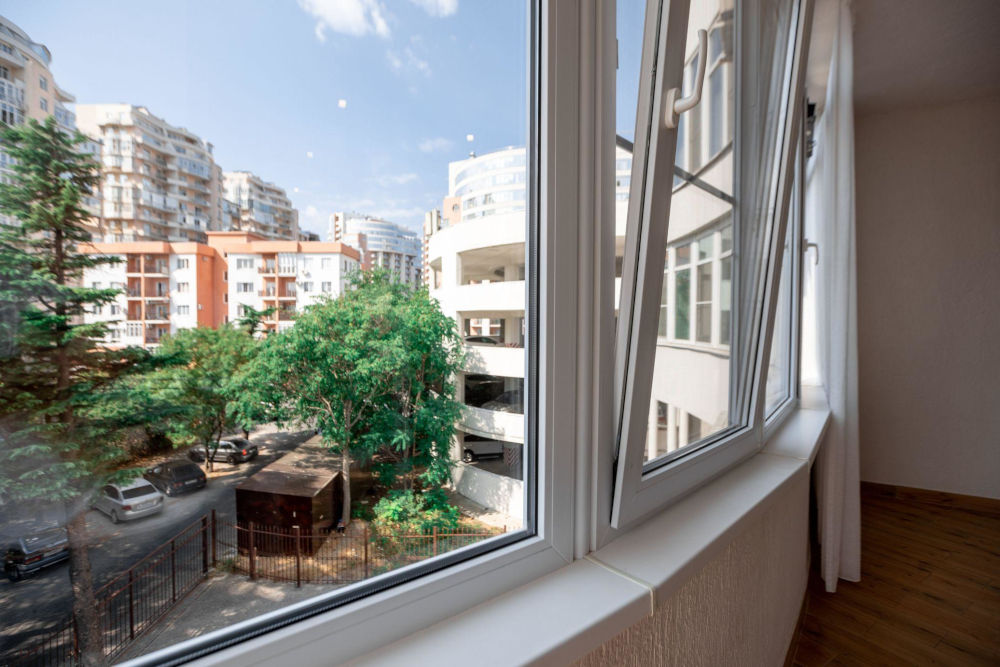

Tilt-and-turn windows pay off when you want a small vent you can leave open, and a way to wash the outside pane from inside the room; the hardware is wasted when the sash has no arc to swing through. One handle runs both openings. When closed, the sash pulls into a seal on all four sides. That combination is the benefit. The room has to be able to take the swing, or the second opening never gets used.
The everyday position is the tilt. The top of the sash leans into the room by a few inches, the gap stays narrow, and rain stays outside. Air comes in without a sash hanging over a deck, a walkway, or a side yard. Nothing on this window projects past the outside of the wall.
The occasional position is the turn. The same sash swings inward on side hinges, so the outside of the glass is in reach, and a clear opening can serve as a bedroom escape when the size and the swing both qualify. Order sheets sometimes shorten the name to tilt-turn windows. The hardware is still one sash working on two axes, built to the measured opening rather than to a catalogue size.
Key Takeaways
- On most days, the useful opening is the tilt: a narrow gap at the top that vents the room while the sash stays in the frame.
- The turn lets you wash the outside pane and turns a bedroom opening into an escape route, and it needs a clear arc inside the room.
- Closed, the multi-point lock draws the sash into twin compression seals on all four sides, giving you air, water, and sound advantages over a track window.
- The screen is fixed on the outside, unlike a casement, because the sash comes into the room.
- A blind or a piece of furniture in that arc is usually why the turn never actually opens.
- Installed budget bands run from $800 to $1,560 in double pane and from $930 to $1,800 in triple pane, with a medium opening starting at $920.
- The tilt is not the escape opening. Only a full turn can meet bedroom egress size requirements, and only when the swing is clear.
What do tilt-and-turn windows actually change in a room?
Tilt-and-turn windows change the room by giving you a vent you can leave open and a full opening you use on purpose, from hardware that locks on all four sides when it is shut. Both jobs sit on the same sash, and both of them come inward. The tilt-and-turn window is built to the opening that was measured, so the benefit shows up only if that opening, and the furniture around it, can take the sash.
What does the tilt position give you?
Turn the handle one way, and the top of the sash leans in. The gap is a few inches, not a doorway. Air moves, the opening is too narrow for a person, and the glass above the gap still sheds rain to the outside. Weather Pro describes that position as secure against break-ins for that reason: the sash has not left the frame, and locking points around the opening stay in play while the top is tipped.
That is the position for cooking steam, a bedroom overnight, or a living room that needs fresh air without a meeting about the thermostat. It is also the position that does not ask the floor for space. A chair, a desk, and a blind can stay where they are, because the sash barely enters the room. If all you need is a crack of air, you may never use the second position, and the window still earns its place.
The tilt has a hard limit. The gap does not clear the opening, so it cannot be a bedroom escape, and it cannot pass anything larger than that crack. Leaving it tipped through a long cold spell trades heated indoor air for outdoor air, and that trade has a cost.
What does the turn position give you?
Turn the handle the other way and the sash comes into the room on side hinges, the way a door leaf swings. The outside pane faces you. You can wash it from the floor, which is the point on a stair landing or a second storey where a ladder means moving shrubs, opening a gate, or standing on furniture. The opening that is left in the wall is the full measured opening, with the sash parked inside rather than blocking the hole.
That full opening is what counts as a way out of a bedroom, and only that position qualifies. The clear hole must meet the size a local advisory requires, and the sash must stay open on its own hardware. The tilt fails that test because the hole is only the top gap.
The turn also needs an empty arc inside the room, past the sill, the blind, and anything parked in front of the glass. The screen stays outside, so it isn’t in your hand while you wash. Those two facts decide whether the turn is a habit or a feature you use twice a year.
Where do the pros and cons show up in daily use?
The pros and cons of tilt-and-turn windows don’t cancel each other out. The pros show up whenever you want air without a wide hole, and whenever you wash the glass from the room. The cons show up as soon as the arc is blocked, the screen must be serviced from outside, or the quote is compared with a simpler operator. A homeowner who only reads the closed-window seal will miss what actually causes callbacks: the sash that cannot finish its swing.
The gains are jobs the hardware can do. The costs are the conditions those jobs need.
- A vent you can leave. The tilt keeps a narrow opening at the top while rain stays outside and the sash remains in the frame.
- Glass you can reach. The turn puts the outside pane in the room, so a second-storey wash does not start with a ladder.
- A seal on four sides. When shut, the lock draws the sash into twin compression seals around the frame, blocking air, water, and sound.
- No outdoor projection. Decks, walkways, and tight side yards stay clear, because neither position swings past the wall.
- One handle, two axes. You don’t keep a separate hopper for air and a separate door-style sash for cleaning.
The costs sit beside those jobs. The hardware is heavier than a casement crank, which is why this is the most expensive operating style Weather Pro builds. The open sash occupies floor space, so a sofa tight to the wall or a sill full of plants stops the turn. The screen is outside, so washing the glass does not wash the mesh. A handle that will not travel cleanly is a reason to stop, because both openings share one lock set.
Why does the European pattern seal on four sides?
European tilt-and-turn windows name an operating pattern: an inward tilt and an inward turn on one handle. The vinyl units Weather Pro manufactures for Canadian replacement openings are built to fit the hole in the wall. The pattern matters when the handle is fully closed. Overlapping sash and frame carry twin seals around the whole perimeter, and the multi-point lock pulls the sash into those seals.
A track window seals by contact, and wind along the wall can work at that contact. A compression seal is pulled shut, so the same wind pushes the sash toward the seal. Weather Pro treats this as the tightest operating window, built to resist air, water, and sound, thanks to that lock and those twin seals. Closed is the position that earns the seal. Tilted is a vent.
The same perimeter seal is why street noise drops when you replace a tired slider with this style, and why the glass package is still its own decision. Sound finds the gap first. Once the gap is closed, what is left is the glass, the space between the panes, and how the unit was fastened to the wall. Soundproof windows are that second decision: laminated glass, different pane thicknesses, and a tested assembly, plus a sash that already closes tight. Buying the hardware and leaving a hollow around the frame gives the noise a path the lock cannot shut.
A casement window also closes by compression. The crank pulls the sash into weatherstripping on four edges, and wind on the outside pushes it further into the frame. The casement sash lives outside the wall when it is open, and the screen lives inside. Tilt and turn spends the extra hardware on a second axis and on lock points that stay engaged in the tilt. If the opening already wants an outward sash, the casement does the seal without asking the living room for an arc.
How does the style behave through a Canadian winter?
In Canada, people judge tilt-and-turn windows in January. The heating season is long, and a window that only works when it is swung fully open spends that season shut. Tilt is the air change you can take when you don’t want the outdoor temperature in the room by the square metre. The turn waits for the wash, or for the day you need the hole.
Health Canada notes that Canadians spend about 90% of their time indoors, and that ventilation solely by window opening can lead to excessive energy costs, particularly due to heat loss in winter or conditioned-air loss in summer. A full inward swing is a large hole. A tilt is a controlled one. Using the tilt for an hour and closing it is a different heat bill from parking the sash open because the only vent you own is an all-or-nothing slide. Mechanical ventilation still does the steady work in a tight house. The window is the extra air you choose, not a substitute for a fan that runs all night.
When outdoor air is poor, close the sash. Wildfire smoke or a smoky chimney comes through a tilt as well as through a wide opening, only more slowly. The tilt brings in outdoor air. It does not clean that air.
When wind drops off the mountains and lifts the temperature through freezing in a single afternoon, a wide opening throws away heat you will want again after sunset. That swing is why Calgary window replacement on an upper floor often keeps the sash tilted through the thaw and saves the full turn for a calm wash day.
Farther from that mountain wind, a cold spell can sit on the house for weeks, and the expensive air is the air you heated. That is why Edmonton window installation in a bedroom treats the tilt as the winter vent and treats the full swing as an opening you use and then close. The hardware is the same in both cities. The number of hours you leave it tilted is not.
The glass follows the wall, and the handle stays the same. Double pane with a low-e coating and argon is standard. Triple pane adds a third pane and a second sealed cavity, which cuts heat loss and trims outside noise. On the Prairies, triple pane is the common specification on north and west walls. A sunnier wall can stay on double pane. Either package still tilts and still turns.
Can you clean the outside pane from inside the room?
Yes, in the turn position, and that is the benefit people buy the style for after the first winter of a second-storey bedroom. The sash swings in until the outdoor surface faces the room. You wash it the way you wash the indoor surface: a cloth, a dry edge, a floor you can stand on. You are not leaning past a slider that only opens halfway, and you are not cranking a casement and then reaching around the outside of the sash.
Two things still have to be true, or the benefit stays on the brochure. The arc has to be empty. A crib, a desk return, or a blind that hangs into the swing stops the sash before the outdoor pane has turned far enough to wash. And the glass you are washing is the pane, not the screen. The screen stays on the exterior. If the mesh is the dirty part, someone still has to go outside, or work from a balcony, to take it off. Confusing those two jobs is how someone who was fighting the screen describes a tilt-and-turn as hard to clean.
Support the sash on its hinges while you wash. If it drops, scrapes, or will not stay where the handle left it, stop and have the crew adjust it. Forcing a two-axis lock while the sash is half-turned breaks the handle, and the window then sits neither tilted nor shut. The inward swing removes the ladder on an upper floor. It still requires a pane you can reach without standing on the sill, so a transom high in a stairwell can be this style and remain awkward to wash.
Which coverings still clear an inward swing?
Blinds for tilt-and-turn windows have to live with a sash that enters the room, so the covering belongs in the window order. A blind mounted on the sash travels with the glass as the sash turns and the fabric clears the frame. A blind mounted inside the opening, the way many casement openings are dressed, sits in the arc and stops the turn short.
The screen is fixed on the exterior. That is the opposite of a casement, where the screen sits indoors because the sash goes out. You wash the mesh from outside. If insect season matters on that wall, plan that access when the opening is measured.
“The thing that stops the turn is rarely the hardware. A blind hung for a sash that swings the other way puts the stack or the wand in the arc, and the full opening never happens. We check that path, and the outside screen, before the unit is ordered,” says Chris Perry, Project Manager, Weather Pro.
A few coverings keep the arc:
- A blind on the sash. It turns with the glass, so the stack doesn’t sit in the room to stop the swing.
- A headrail tight to the ceiling. The fabric stacks above the arc instead of hanging through the middle.
- Curtains on a rod past the swing. The panels park on the wall beside the frame, clear of the open sash.
- Nothing on the sill. Plants, speakers, and a deep stack of books are the quiet version of the same collision.
A roller blind cut to the old opening, a wand in the centre of the glass, or a shade set an inch off the frame will meet the sash on the first turn. If a person cannot stand in that arc with the blind fully raised, the blind is in the way.
When does a large sash earn the steel in the frame?
Large tilt-and-turn windows earn the reinforcement when the opening is wide enough that a single casement sash would be too much mass on a crank at full extension. The rigid vinyl frame carries galvanized steel, which lets the style go wider than a standard casement while the sash still closes into a compression seal. Sunlight and a clear view are the reasons people ask for that width. Steel is what keeps the sash from twisting as it enters the seal.
Width is not free clearance. A large sash swings a large arc. In a living room, the arc may cross a sofa, a floor lamp, or the edge of a dining chair that only sits there in the evening. The tilt still works, because the top barely enters the room. The turn, which is the reason you accepted the weight, needs the arc every time you want it. A feature window you can only tilt is a fixed window with an expensive handle.
Larger units need heavier reinforcement and more hands on site, which is one reason prices rise faster than glass area. If the view is the goal and the vent can live beside it, a fixed pane with a smaller operator next to it keeps the sightline and gives you a sash you can actually turn. Fixed units and combinations are built in the same system, including in a bay, so the elevation can match. The large operator is the right sash when that whole opening has to swing in.
What does the installed price look like by size?
As a budgeting range, tilt-and-turn windows run from $800 for a small double-pane unit to $1,800 for a large triple-pane unit. A medium opening starts at $920 installed, compared with $610 for a single hung of that size. The gap is the hardware: two axes and locks on four sides. These figures are examples for budgeting. The exact number follows a free in-home measurement.
The bands below are the ones on the pricing page for this style. Small is up to 24 by 36 inches. Medium is up to 36 by 60 inches. Large is over 36 by 60 inches. Double pane is the standard low-e, argon package. Triple pane is the step up.
| Size | Double pane | Triple pane |
|---|---|---|
| Small, up to 24 by 36 in | $800 to $1,190 | $930 to $1,400 |
| Medium, up to 36 by 60 in | $920 to $1,360 | $1,100 to $1,640 |
| Large, over 36 by 60 in | $1,000 to $1,560 | $1,190 to $1,800 |
Across the styles on that page, triple pane adds about 20 percent, with the spread from about 9 percent to as much as 50 percent on the largest sliders. For this hardware, use the table. North and west walls are where the triple-pane step usually gets spent. A sunnier wall can stay double pane and still close on the same lock.
An installed price covers the unit built to the measured opening, removal, insulation and sealing, interior and exterior finishing, cleanup, and warranty registration. The transferable lifetime warranty starts the day of installation. Rot behind the old frame, a structural change, new interior trim on a full-frame replacement, and upper-floor access equipment are quoted separately. Keeping a sound existing frame costs less than going back to the rough opening, and that choice moves the quote more than the vinyl colour.
White is the standard finish. Exterior colour and laminate are an upcharge with no published dollar amount, because the profile is finished rather than left as the standard extrusion. List prices are the same across the provinces Weather Pro serves. What changes by region is the specification, usually double pane versus triple pane, and that is what moves the number. Bay, bow, and specialty shapes are not in this table. They are priced from the opening. The full style-by-style bands, and the note that every range is for budgeting, sit with the window replacement cost figures the company publishes.
When is this the wrong window?
This is the wrong window when the sash cannot finish the turn, when a bedroom escape depends on the tilt, or when the opening needs a sash that projects outside and stays open in rain. Alberta’s rules for this kind of house sit under the National Building Code 2023 Alberta Edition, the code currently in force. The opening still has to satisfy the local reading of a bedroom escape.
A City of Calgary building advisory quotes an unobstructed opening of at least 0.35 m2, with no dimension less than 380 mm, kept open without extra support. It lists a tilt-and-turn as acceptable when the escape position meets the casement or awning requirement without special knowledge, which I read as anything beyond one motion to unlock and one motion to open. A casement in that advisory has to swing a full 90 degrees free of obstructions, and this style has to meet that kind of clear swing. The turn is the position that can clear the hole. A dresser in the arc fails the opening.
The advisory says it is not itself a legal interpretation. It is the city’s written reading, including the line that this style qualifies when the escape position behaves like a casement or an awning. Confirm the swing on site. A sprinklered suite is the exception that article already names, and that call belongs to the inspector.
Rain is the other mismatch. An awning window hinges at the top and opens outward from the bottom, so the glass sits over the hole like a small roof and the window can stay open in light rain. Choose that when the opening is above a counter, in a bathroom, or in a basement well where an inward sash has nowhere to go. The tilt-and-turn also keeps rain out, but it does it by tipping in a few inches, not by sheltering a wider vent. If you want a bigger throat of air during a drizzle, the awning is the operator that was built for that.
An outward crank is the mismatch when the room is tight, and the outside is clear. The pros and cons of casement windows turn on that outdoor swing: a full opening, a screen you clean from inside, and a sash that must miss the deck and the downspout. Pick the casement when that outdoor clearance exists, and you don’t need the sash in the room. Pick a slider when neither swing is available, inside or outside, and half the frame of air is enough. Pick the tilt and turn when the outdoor side is blocked or high, the indoor arc is empty, and you want the four-side seal on the nights the window is shut.
The hardware earns its place when the arc is empty
Tilt and turn is the right operating window when the tilt is the vent you actually use, and the turn has a clear path to wash the glass or clear a bedroom opening. The seal on four sides is what you live with for the other eleven months, and it’s why the style costs more than a hung window of the same size. A blocked arc, an outside screen you cannot reach, or an escape plan that depends on the tilt are the three ways the purchase goes wrong.
Double pane is the standard glass, triple pane is the step for a cold wall, and white is the standard finish. A sound old frame can stay. None of those choices creates an arc the furniture has already filled.
Weather Pro manufactures vinyl windows and exterior doors in Canada and installs them with its own crews, so it checks the handle position, exterior screen, and swing at the measure before building the sash. Most replacement projects are finished in a day. Bring the blind measurement and a note on which openings are bedrooms, and the configuration that comes back will match your room.
Frequently Asked Questions
What are tilt and turn windows?
They are vinyl operating windows with one sash and one handle. One handle position tips the top of the sash inward a few inches for ventilation. The other swings the sash fully inward so you can clean the outside pane and, when the opening is large enough and clear, use it as a bedroom escape. Closed, the sash locks on all four sides.
How do you open a tilt and turn window?
Use the handle. One direction tilts the top in. The other direction releases the sash to swing in on the side hinges. Return the sash to the frame and close the handle to draw it back into the seals. If the handle will not travel, or the sash scrapes, stop and have the hardware checked rather than forcing it.
Do tilt and turn windows have screens?
Yes. The screen is fixed on the exterior, because the sash swings into the room. That is the opposite of a casement or an awning, where the screen sits inside. You can tilt and turn without removing an interior screen. Washing the mesh is an outside job.
How do you clean tilt-and-turn windows?
Swing the sash fully inward and wash both surfaces from the room. Keep the arc clear of blinds and furniture so the outdoor pane can turn to face you. The screen stays outside. If the sash will not stay open on its hinges, do not lift it off the hardware to finish the wash.
Are they secure when the sash is tilted?
The tilt leaves a narrow opening at the top while the sash stays in the frame, which is why Weather Pro describes that position as secure against break-ins and as a way to keep rain out. It is not a full lock-up, and it is not a substitute for closing and locking the handle when you leave. A wide-open turn is an open window.
Do tilt-and-turn windows meet egress?
The turn can, when the clear opening meets the local rule and the sash swings free of obstructions without an odd sequence of moves. A City of Calgary advisory quotes at least 0.35 m2, with no dimension under 380 mm, and it lists this style as acceptable when it opens like a casement or an awning. The tilt position does not clear that opening.
How much do tilt-and-turn windows cost?
Budget bands run from $800 to $1,560 installed in double pane and from $930 to $1,800 in triple pane, by size. A medium opening starts at $920, compared with $610 for a single hung of that size. The exact price follows a measurement. Rot, a full-frame rebuild, and upper-floor access are quoted on top when they apply.
Which blinds work on a tilt-and-turn window?
Blinds that travel on the sash, or that stack clear of the inward arc, leave the turn usable. A blind hung inside the opening, as a casement blind often is, will stop the sash. Check the arc with the covering fully raised before ordering the window, because the screen is outside and will not be what hits the fabric.