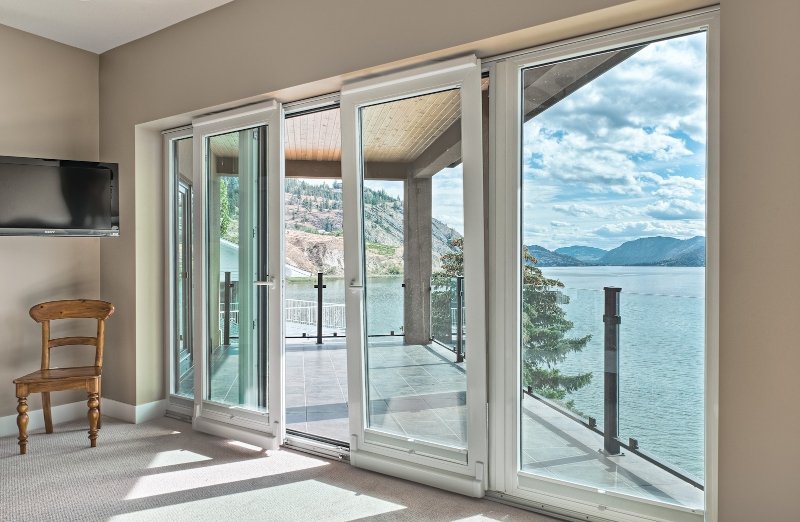
Fixed Casement Window

Weather Pro manufactures vinyl fixed casement windows in Canada and installs them with our own crews. A fixed casement does not open: it matches the frame width and sightlines of an operating casement, so it can sit directly beside one without the join being obvious. Each unit is built to the measured opening rather than to a stock size, with double- or triple-pane glass and a full colour range inside and out. Every window is ENERGY STAR certified and covered by a transferable lifetime warranty.
What is a fixed casement window
A fixed casement is a casement window without the operating sash and hardware. It uses the same frame and the same sightlines as our casement and awning windows, so a fixed unit and an operating unit side by side read as one window.
Fixed units are used where the view matters, with ventilation handled by an adjacent operating window. Because there is no hardware, a fixed casement starts lower in price than any operating style and can be built far larger than an operating one.
A fixed casement is one of our three picture window styles. The other two are the slim fixed picture window, with the narrowest sightlines in our range, and the dimensional picture window, which matches hung and slider windows.
How fixed casement windows are used
A fixed casement is almost always part of a combination, and it is built in the same system as the operating units around it.
Beside an operating casement
The most common use. One or two fixed units carry the view, and the casement beside them cranks open for ventilation, with matching sightlines across the whole opening.
With awning windows
A fixed casement above or beside an awning window keeps the same frame lines and gives ventilation that can stay open in light rain.
On its own
Where the view matters and the room is ventilated elsewhere, a single fixed casement gives a large clear pane in a frame that matches the rest of the house.
Fixed casement window sizes
There is no standard fixed casement size in Canadian replacement work. Every unit is manufactured to the measured opening, because openings in existing homes are rarely square and almost never identical. What does exist is a set of common size bands, and knowing which band your opening falls into is enough to plan a project.
| Band | Approximate opening |
|---|---|
| Small | up to 24 by 36 inches |
| Medium | up to 36 by 60 inches |
| Large | over 36 by 60 inches |
A fixed unit can be built far larger than an operating one, so fixed casements go well beyond the large band. A large custom fixed unit in triple pane is the largest single window we make. Our estimator confirms the size on site.
Why fixed casement windows suit the Canadian climate
A fixed casement has no operating sash, so there is no seal between sash and frame to age or leak. The glass unit sits in a single fixed frame, which is the simplest and tightest window there is.
Every window we build is a vinyl window manufactured in Canada, with a multi-chamber profile that adds insulating air pockets within the frame. Vinyl does not rot, does not need painting, and conducts far less heat than an aluminum frame through a Canadian winter.
Glass packages are double-pane with a low-e coating and argon fill as standard, or triple-pane with a third pane and a second sealed cavity for lower heat loss and reduced outside noise. Both are available ENERGY STAR certified for the climate zone the window is sold into.
Fixed casement window installation
Fixed casement window installation is measured, manufactured and fitted by Weather Pro crews rather than subcontracted trades. Two things get decided during the measurement, and all of them are easier to change before manufacture than after.
01
Retrofit or full frame
A retrofit keeps the existing sound frame. A full-frame replacement goes back to the rough opening and is required when the frame has rot or the opening has shifted.
02
Which unit operates
Which part of the combination is fixed and which cranks open. The fixed units carry the view; the operating unit is placed where it clears walkways and catches the breeze.
Most replacement projects are completed in a single day, and the transferable lifetime warranty is active from the day of installation.
Colours and finishes
White is the standard finish. Exterior colours and laminate finishes are available across the full range, and the interior can be finished differently from the exterior where the room calls for it.
The colour either runs through the vinyl profile or is applied as an exterior laminate, so it is not paint sitting on a surface. That means no repainting, no flaking and no chalky finish after a few Canadian winters.
A few things worth knowing before you choose:
- Most homeowners match the exterior to the soffit or the trim rather than the siding, since the frame reads as trim from the street.
- A white interior with a coloured exterior is the most common combination.
- Woodgrain interior laminates suit rooms that already have stained trim.
- Darker laminates absorb more solar heat, which matters on large south and west facing units.
Frequently asked questions
What is a fixed casement window?
+
A fixed casement is a casement window that does not open. It keeps the frame width and sightlines of an operating casement, so it sits beside one without the join being obvious, and it is used where the view matters with ventilation from the window next to it.
What is the difference between a fixed casement and a picture window?
+
Both are fixed. A fixed casement matches the frame lines of casement and awning windows. A slim fixed picture window has the narrowest sightlines for the largest glass area, and a dimensional picture window matches hung and slider windows.
Do fixed casement windows open?
+
No. A fixed casement has no sash and no hardware. Ventilation comes from the operating casement or awning window beside it.
How much does a fixed casement window cost?
+
Installed picture and fixed casement windows run from $480 to $2,100 in double pane and from $580 to $2,520 in triple pane, depending on size. They start lower than any operating style because there is no hardware. The full price list by style and size is on our pricing page, and the exact price is confirmed after a free in-home measurement.
How long do vinyl fixed casement windows last?
+
A quality vinyl window typically lasts 25 years or more. The frame usually outlives the sealed glass unit, so the first sign of age is a fogged pane from a failed seal rather than a failed frame. Manufacturing defects are covered by a transferable lifetime warranty.
Let’s Get You FREE Pricing
Get Started Now
This month specials
limited time offer
MONTHLY PAYMENTS up to $49 per month
0% OFF
0% OFF
0% OFF